For property owners across Cherokee County, Ball Ground, and Canton with mature trees near their homes, driveways, and regularly occupied outdoor areas, understanding the specific tree damage categories that are easiest to overlook because they present at conditions less obvious than the overt structural failures that finally make them undeniable, what to look for in each category that makes the less-visible conditions identifiable before they reach the obvious stage, and how to translate identified conditions into the management response that the specific condition at its current stage specifically warrants gives the practical knowledge for approaching tree assessment near the home as the condition-specific systematic practice that captures the less-visible damage in time to respond before the damage reaches the stage where the response options have narrowed to the more limited and more expensive alternatives that later-stage discovery constrains rather than the broader options that earlier identification specifically maintains.
Why Tree Damage Is Often Less Visible Than Property Owners Expect
Tree damage is often less visible than property owners expect at the stages when management response is most beneficial because the biological and structural systems that damage compromises are largely internal, below-ground, or covered by bark and foliage in ways that make external expression of internal conditions limited to the specific surface and canopy manifestations that trained observation specifically looks for rather than the obvious structural failures that casual observation cannot miss at the later stages when structural compromise has advanced to the surface expression stage that external observation captures without the systematic assessment that earlier-stage identification requires.
Wood decay that is consuming structural wood from the inside outward may not produce external bark changes detectable from standing height at ten feet of distance from the trunk until the decay has consumed a significant fraction of the structural wood volume, because the bark’s protective function continues at the surface while the decay organism consuming the wood beneath it advances through the structural wood at the rate that the organism’s metabolic activity drives rather than at the rate that external bark condition change would visibly indicate. Root system damage below the soil surface similarly produces no visible above-ground indicators until the root system’s structural anchoring has been sufficiently compromised that the above-ground tree’s lean, soil disturbance, or canopy stress response creates the visible above-ground expression that the below-ground damage has advanced to producing. Canopy decline from systemic functional problems may advance across multiple seasons at the rate that progressive physiological decline drives before the thinning is obvious enough from casual observation to be noticed without the annual photographic comparison that systematic assessment conducts at the same seasonal canopy development stage each year and that reveals the progressive change that single-point observation without the prior-season comparison baseline cannot identify as progressive rather than stable.
Identifying Cracks and Structural Damage That May Not Be Obvious
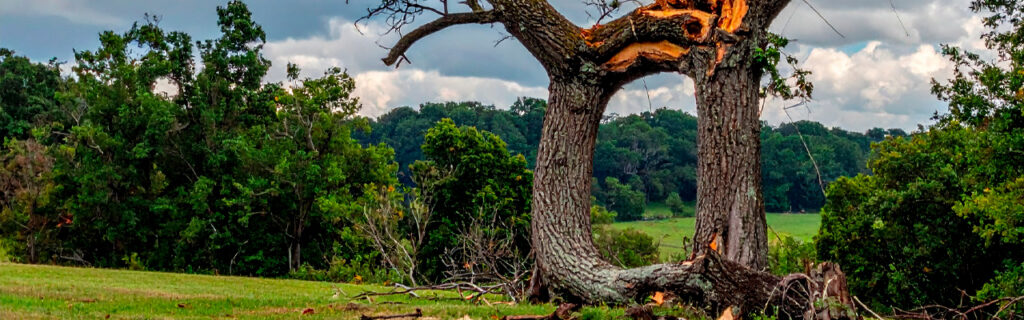
Structural cracks in tree trunks and major branch unions are among the least visible categories of significant tree damage because they may be present at the bark surface as subtle seams, depressions, or abnormalities that require close-proximity trunk inspection from multiple angles to specifically identify rather than the obvious open splits that the most advanced crack development eventually produces at the stage when the structural compromise has reached the surface visibility that passive observation captures without systematic assessment.
Bark Seams and Vertical Cracks
Vertical seams or cracks running along the trunk surface between the root flare and the first major branch union indicate tension or compression forces separating the wood tissue along the seam line, potentially revealing a structural crack within the wood below the bark that the bark-surface seam expresses as the external manifestation of the internal structural separation. These bark seams are most identifiable at close-proximity trunk inspection when the low-angle light of early morning or late afternoon creates shadows in the surface irregularities that flat midday light flattens into the bark surface texture that disguises the seam against the surrounding bark without the shadow-revealing low-angle illumination that makes the seam visually distinguishable. Inspecting the full trunk circumference at close proximity under low-angle lighting conditions, specifically looking for any linear irregularities in the bark surface texture that follow a vertical or diagonal direction rather than the random bark pattern that normal bark texture produces, identifies these bark seams at the stage when they represent internal structural separation potentially worth professional assessment rather than at the stage when the seam has widened into the obvious split that casual observation captures without the close-proximity systematic inspection that bark seam identification at earlier stages requires.
Co-dominant Stem Union Cracks
Co-dominant stems on mature trees near the home may develop cracks at or near the union between the stems that are not visible from the ground level at the distances that routine property observation uses, but that are specifically present and potentially significant at the union positions where the bark inclusion that V-shaped included bark unions create represents the structural weakness that lateral wind loading can exploit to split the stems apart at the included bark plane. The crack development at included bark unions may be identifiable from below as the bark seam or separation at the union position that close-proximity inspection from directly below the union reveals at the upward-looking observation angle that ground-level inspection specifically adopts for union assessment, but that the standard horizontal observation angle from standing height at distance from the tree provides inadequate sight-line geometry to identify at the same accuracy as the upward-looking close-proximity position. Assessing co-dominant stem unions on mature trees near the home by approaching the union to the closest ground-level position below it and specifically looking upward at the union from directly below provides the observation angle that union crack identification benefits from at the ground-level assessment position that property owners can access without climbing equipment.
Storm-Produced Cracks That Closed After the Storm
Significant storms that apply substantial wind loading to trees near the home may produce structural cracks in the wood that partially close when the storm loading is removed and the tree’s elastic response to the load removal partially reverses the crack opening that the storm-induced loading created during the storm’s peak. These partially-closed storm-produced cracks represent structural damage that the storm created and that the post-storm elastic closure partially conceals from the obvious visibility that the fully-open crack presented during the storm’s peak loading. Post-storm inspection of priority trees near the home within twenty-four hours of any significant storm event specifically assesses for these storm-produced partially-closed cracks by looking for the bark separation, sap weeping, or wood fiber exposure at the crack margins that identify the crack position even after partial elastic closure has reduced the crack width below the easily-obvious dimension that the fully-open storm-loading stage presented. Any storm-produced crack, regardless of the partial closure extent, at a trunk or major branch union position on a tree near the home warrants prompt professional assessment that evaluates the crack extent and structural significance before the next storm applies loading to the previously cracked structural position that the prior storm’s crack has compromised relative to the pre-crack structural integrity that the partially-closed appearance incompletely represents as a still-adequate structural condition without the professional assessment that the crack’s actual depth, extent, and structural significance requires to be specifically evaluated.
Identifying Dead Limbs That May Not Be Immediately Obvious
Dead limbs in tree crowns are most definitively identified during the late-summer growing season when all living branches should be carrying maximum foliage and the leafless dead branches are most visually distinct against the fully-leafed living crown that surrounds them. However, not all dead limbs in the crowns of trees near Cherokee County homes are located at positions that ground-level observation easily reaches, and the dead limbs most concerning for their proximity to the home and for their potential to fall on the home’s structure, driveway, or occupied outdoor areas may be in the inner crown positions that the outer crown’s foliage partially obscures from ground-level observation rather than in the outer crown positions where the contrast with surrounding foliage makes dead branch identification most straightforward.
Inner Crown Dead Wood That Foliage Conceals
Inner crown dead wood that accumulates at scaffold branch positions within the crown interior rather than at outer crown branch tips is specifically less visible from ground-level assessment positions because the outer crown foliage mass that surrounds the inner crown positions intercepts the sight lines from ground-level observation positions, reducing the visual penetration into the inner crown that the outer foliage allows from below or from the side rather than the unrestricted inner crown sight lines that dormant-season observation without foliage mass achieves. Maximizing the inner crown visibility available from ground-level summer assessment requires moving to multiple observation positions that provide sight-line angles into the inner crown from different positions around the tree, specifically including positions that look upward through crown openings where the outer foliage mass thins, creating sight-line windows into the inner crown that the average-density foliage positions do not provide. Looking upward through these crown opening positions from directly below the tree trunk provides the most direct inner crown sight lines available from ground level, and the dead scaffold branches within the inner crown are most identifiable from these below-the-crown upward-looking positions rather than from the standard horizontal observation positions that outer foliage interception limits to outer crown assessment without the inner crown penetration that upward-looking assessment through crown openings provides.
Partially Dead Branches With Mixed Living and Dead Sections
Branches that are partially dead, carrying living foliage at some positions along their length while carrying no foliage at other positions where the branch’s conductive capacity has declined below what foliage support at those positions requires, present a less visually obvious dead branch indicator than the completely leafless dead branches that dead branch identification most readily identifies. A branch carrying full foliage at its base and middle sections while carrying no foliage at its distal tip sections is partially dead at the tip while still alive at the basal sections, and the dead tip section’s weight and brittleness creates the falling debris risk that tip-section failure at the living-to-dead transition produces when storm loading or progressive brittleness at the transition eventually separates the dead tip from the living section that supports it. Assessing for partial dead branch conditions specifically requires following each significant branch from its origin at the trunk or scaffold limb through its full length to the tip, looking for the transition from foliage-bearing to non-foliage-bearing along the branch’s length that identifies the partially-dead condition rather than the fully-dead condition that the entirely leafless branch identification most straightforwardly detects.
Identifying Root Disturbance That May Not Be Immediately Visible
Root disturbance and root system damage on trees near Cherokee County homes is among the least visible tree damage categories because the root system exists below the soil surface where direct observation requires excavation that property owners do not conduct during routine assessment, and the above-ground indicators of below-ground root system conditions are the secondary expressions that root system damage eventually produces in the above-ground tree rather than the primary below-ground conditions themselves.
Soil Upheaval and Surface Cracking at the Root Zone
Soil upheaval or surface cracking at the root zone around the base of trees near the home indicates that the root system beneath the upheaval position is experiencing the mechanical forces that produce the soil surface disturbance visible above the roots. On the side opposite a tree’s lean direction, soil upheaval that creates a raised ridge or series of cracks at the soil surface adjacent to the root flare indicates root plate rotation where the root system’s structural anchoring on the tension side of the lean is pulling upward against the soil above the root plate as the tree’s lean loads the root plate’s tension side with the mechanical force that rotation produces in the root plate below. This soil surface upheaval may be subtle in its early stages, presenting as slightly raised ground on one side of the trunk that careful ground surface observation specifically identifies rather than the dramatic soil mounding that advanced root plate rotation eventually produces at the stage that casual observation captures without the specific close-proximity root zone assessment that the subtle early stage requires. Examining the ground surface around the full root flare circumference at close proximity during each assessment cycle, specifically looking for any asymmetric soil surface disturbance that was not present at the prior assessment cycle, identifies this soil upheaval indicator at its earliest observable stage rather than at the advanced stage that casual observation at standing height from routine walking-distance positions identifies without the specific root zone surface assessment that the subtle early stage requires.
Construction and Disturbance Damage to Root Zones
Root zone damage from construction activities, trenching for utility installation, compaction from equipment operation within the root zone, and grade changes that alter the soil moisture and oxygen conditions in the root zone are sources of tree root damage that may not produce observable above-ground tree stress indicators until one to several years after the damaging activities occurred, because the root system’s decline from construction damage typically advances through the affected root zone progressively before the root’s functional decline reaches the above-ground water and nutrient supply reduction that canopy stress indicators express at the canopy above the damaged root system. Property owners who have had construction activities within or adjacent to the root zones of mature trees near their homes should include the trees adjacent to those construction areas in their systematic assessment program and specifically note whether the canopy health observations at each assessment cycle show any decline relative to the prior cycle that the root zone damage may be expressing as the above-ground stress response that the below-ground root system decline progressively produces in the canopy above it. The assessment cycle after significant construction near mature trees should specifically establish the current-condition canopy documentation baseline that subsequent cycles can compare against to detect the progressive canopy stress that construction root zone damage produces rather than the stable canopy condition that trees without construction root zone damage maintain across comparable assessment cycles without the progressive decline that root zone damage eventually drives in the canopy above the damaged root system.
Identifying Canopy Changes That May Not Be Immediately Visible
Canopy changes that indicate tree health problems are among the most diagnostically informative tree assessment findings available from ground-level property owner observation, but they require the multi-season comparison framework that annual photographic documentation provides to distinguish the progressive change that systemic problems drive from the single-season variation that stress events create without the progressive multi-season trajectory that systemic functional decline produces as a distinguishable pattern from the stable or rebounding trajectory that stress-event responses produce.
Premature Fall Color in Specific Crown Sections
Premature fall color development in specific crown sections while the surrounding crown remains in full summer green, specifically in late summer when the surrounding canopy should not yet be showing any fall color transition, indicates that the vascular supply to the prematurely coloring sections has declined below what the section’s foliage requires to maintain active photosynthesis, producing the premature stress senescence that the foliage expresses as early color change before the whole-tree hormone-driven fall senescence that synchronous full-canopy fall color represents. This premature section-specific early color is not the gradual overall canopy greening reduction that progressive canopy thinning produces over multiple seasons, but the specific crown section or branch group discoloration that appears early and specifically rather than uniformly across the full canopy, indicating a localized vascular supply problem at the specific branch or scaffold group showing the premature color rather than the whole-tree functional decline that uniform canopy thinning expresses. Specifically observing the crown from multiple positions in late summer for any sections showing yellow, orange, or brown coloration that the surrounding crown has not yet expressed as fall color provides the premature section-specific color identification that this localized vascular supply problem creates as its above-ground expression, and noting the crown position and extent of any premature coloring at the late-summer assessment documents the finding for the professional assessment that premature section-specific color on a home-adjacent tree specifically warrants.
Leaf Size Reduction in the Current Season
Leaf size reduction in the current season’s foliage relative to the same tree’s prior-season leaf sizes at the same seasonal development stage indicates that the resources the tree is allocating to each year’s leaf production have declined from the prior-season level that supported larger leaf production, reflecting the physiological resource limitation that root system damage, systemic functional decline, or specific pathogen pressure produces as the resource allocation reduction that reduced leaf size expresses at the current season’s foliage compared to the prior-season foliage at the same seasonal stage. Leaf size comparison between current and prior seasons requires either retaining prior-season leaf photographs for comparison or specifically examining the leaf sizes on the current-season foliage against the sizes that the property owner recalls from the prior season at the same general observation position. The leaf size reduction indicator is more specifically identified by examining foliage at consistent positions within the crown across successive seasons rather than comparing across different crown positions where normal within-crown leaf size variation that sun exposure and position create would confound the between-season comparison that leaf size reduction as a health indicator requires to specifically reflect seasonal change rather than position-related variation within the same season’s foliage.
How to Make Less-Visible Damage More Discoverable Through Assessment Timing and Technique
The less-visible damage categories described in this article are less visible not because they are inherently undetectable but because they require specific assessment timing, observation techniques, and comparison frameworks that casual observation without these specific practices does not employ and therefore does not capture at the stages when the damage is present but not yet advanced to the obvious stage that observation without these practices would identify.
Assessment timing that specifically uses post-rain conditions for basal fungal fruiting detection, late-summer full canopy conditions for dead branch identification, and low-angle early morning or late afternoon lighting for bark seam and crack detection captures the timing-dependent visibility windows that each damage category presents most clearly at specific conditions rather than at the average conditions that routine observation employs without specifically seeking the timing that maximizes each damage category’s visibility. Observation techniques that physically move to the close-proximity positions that basal assessment, root zone surface assessment, and inner crown upward observation require rather than observing from the standing-height at-distance positions that routine observation uses without the position-specific adjustments that each damage category’s visibility benefits from at the specific positions and angles that maximize its detectability from ground level. Comparison frameworks that establish the photographic documentation at each assessment cycle that progressive change detection requires to distinguish multi-season trajectories from single-season variation, and that specifically look for change from the prior-cycle documentation rather than only assessing the current-cycle conditions without the prior-cycle comparison that progressive change identification requires.
Frequently Asked Questions
How do I determine when identified less-visible damage warrants professional tree assessment versus continued monitoring?
The threshold between continued monitoring and professional assessment for identified less-visible damage on trees near Cherokee County homes is most productively determined by combining the damage category’s structural significance with the tree’s position relative to the home and occupied areas rather than by the damage’s severity alone without the position context that gives each condition its specific consequence framework. Any basal fungal fruiting at the root flare of a tree within fall distance of the home warrants prompt professional assessment regardless of the fruiting body size or number, because basal fruiting confirms active structural wood decay at the most consequential structural zone regardless of the early stage that small or limited fruiting may represent. Any storm-produced crack in the trunk or at a major branch union of a home-adjacent tree warrants professional assessment before the next significant storm event regardless of whether the crack has partially closed after the storm’s loading was removed. Progressive canopy thinning across three or more seasons on a tree within fall distance of the home warrants professional assessment that evaluates whether systemic functional decline is associated with structural compromise rather than continued monitoring through additional storm seasons that test the declining tree without the assessment that the progressive indicator specifically warrants. Conditions that identify less severe indicators such as minor bark surface irregularities without seam characteristics, single-season canopy stress without prior-season decline documentation, or soil surface conditions that may or may not represent root zone disturbance can appropriately be continued monitoring subjects with documentation for comparison across subsequent assessment cycles rather than immediate professional assessment triggers.
Are there specific seasons when less-visible tree damage is more detectable than others?
Different less-visible damage categories are most detectable at different seasonal timings, making the two-cycle assessment program that combines growing-season and dormant-season assessment more comprehensive for less-visible damage detection than either cycle alone. During the growing season, specifically late summer, canopy health indicators including dead branch identification, premature section-specific color change, canopy thinning progression relative to prior-season documentation, and leaf size changes are most detectable because the full canopy development makes these indicators most visually distinct and most directly comparable to prior-season documentation at the same development stage. Basal fungal fruiting detection is most productive during the growing season’s post-rain periods when warm temperatures and wetting events trigger the fruiting activity that produces the above-ground fruiting bodies most detectable within twenty-four hours after significant rain events. During dormancy, structural indicators including bark seams, trunk cracks, co-dominant stem union conditions, and inner crown dead wood accumulation are most detectable because the leafless canopy removes the foliage that growing-season assessment interposes between the observer and the structural conditions that dormancy exposes to unrestricted inspection from ground-level positions. The two-cycle program that conducts the growing-season assessment for canopy health and basal fruiting indicators combined with the dormant-season assessment for structural and inner crown conditions captures the full range of less-visible damage categories across the seasonal timing windows that each category’s detectability is highest within.
How does the presence of multiple smaller less-visible damage indicators on the same tree change the assessment and response approach?
Multiple smaller less-visible damage indicators on the same tree should be treated as a more significant combined indicator than any single indicator alone, because the co-occurrence of independent indicators reflecting different damage categories on the same tree suggests that the tree’s overall condition is compromised at multiple biological and structural levels rather than at the single level that an isolated indicator represents. A tree showing minor bark seam characteristics at the lower trunk, modest canopy thinning relative to prior-season documentation across two seasons, and soil surface asymmetry at one side of the root flare that may indicate early root zone disturbance has three independent indicators from three different damage categories, each of which might individually fall below the professional assessment threshold that would apply to that indicator in isolation at a home-adjacent priority position, but whose collective presence on the same tree suggests a comprehensive condition assessment rather than the per-category threshold evaluation that single-indicator assessment employs. The appropriate response to multi-indicator findings on home-adjacent trees is professional assessment that evaluates the full condition picture that multiple indicators collectively suggest rather than the per-category monitoring that each indicator’s individual threshold assessment would warrant in isolation from the multi-indicator context that co-occurrence on the same tree creates as the more significant combined indicator that the professional assessment should evaluate comprehensively.
How should less-visible tree damage identified near the home be communicated to a professional tree service when scheduling assessment?
Less-visible tree damage identified near the home should be communicated to a professional tree service through the specific documentation that the systematic assessment produced rather than the general concern that undocumented observation generates without the specific condition evidence that professional assessment scheduling and urgency calibration requires to be accurate. Sharing the dated photographs that the assessment documentation captured at each identified condition, with written notes describing each condition’s specific location on the tree, the assessment timing and conditions under which it was identified, and its change status relative to prior assessment cycles, gives the tree service professional the specific current-condition context that allows the assessment’s urgency and scope to be calibrated to the specific documented conditions rather than the general concern without specific evidence that the professional assessment would need to evaluate from scratch without prior documentation. The urgency communication that the documented conditions warrant should specifically distinguish the conditions that warrant prompt response before the next significant storm event from the conditions that can be scheduled at the next routine service interval, because the professional tree service’s scheduling response to the communication appropriately differs between these urgency levels and the communication that specifically identifies which documented conditions create which urgency level produces the scheduling response that each condition’s urgency specifically warrants rather than the uniform scheduling response that urgency-undifferentiated communication produces without the specific urgency context that the documented conditions and their home-adjacent fall zone positions create.
Ready to Look More Carefully at Trees Near Your North Georgia Home?
The less-visible tree damage that systematic assessment finds on the home-adjacent trees of Cherokee County residential properties is the damage at the stages when management options are broadest, least expensive, and most capable of preventing the structural failures that the damage eventually produces at the obvious stage that casual observation captures when management options have narrowed to the more limited and more costly alternatives that later-stage discovery constrains. The bark seams that close-proximity trunk inspection finds at the stage when intermediate management options still exist, the canopy thinning that annual photographic comparison detects at the two-season stage before the five-season stage that casual observation finally notices, the root zone soil disturbance that close-proximity ground surface assessment identifies at the early subtle stage before the dramatic soil mounding that advanced root plate rotation eventually produces, and the inner crown dead wood that upward observation through crown openings finds at the current-season stage before it falls undetected as the future storm’s trigger are each conditions that the assessment practices described in this article find at stages when they are specifically addressable through the management options that earlier identification maintains as available rather than the options that later-stage discovery finds have narrowed to the more limited alternatives that advanced conditions constrain.
Bardin Outdoors works with homeowners across Ball Ground, Canton, Cherokee County, and North Georgia to evaluate and address the specific tree removal needs that systematic assessment of less-visible damage near the home identifies as warranting professional response, from dead branch removal that addresses specific overhead hazards identified through systematic crown assessment to full tree removal of structurally compromised trees whose less-visible damage assessment has revealed conditions making continued presence near the home specifically consequential before those conditions advance to the obvious stage that later identification would have made the only remaining discovery timing. To learn more about how Bardin Outdoors can help address tree damage near your North Georgia home, contact us.