Not every property that needs clearing needs the same kind of clearing. A homeowner whose lawn edge has been progressively colonized by privet and multiflora rose over several seasons needs vegetation removed from a defined area at a scale and density that a different clearing approach serves than what a property owner converting ten acres of mature woodland to a building site and pasture requires. Between these two extremes lies a range of clearing situations, each with its own vegetation density, intended subsequent use, and appropriate clearing method, and the decision about which approach fits a specific situation is consequential because the wrong approach either produces a site condition that does not serve the intended subsequent use or costs significantly more than what the specific situation actually requires. Commissioning full clearing with stump removal for a situation that needs light brush removal is an expensive overcorrection. Commissioning light brush removal for a situation that requires complete vegetation and root system removal before structural subgrade preparation is an inadequate response that the subsequent use will reveal as insufficient.
For property owners across Cherokee County, Ball Ground, and Canton evaluating clearing needs on their residential and rural lots, understanding the specific characteristics that distinguish light clearing situations from full clearing requirements, the intended subsequent uses that determine which clearing depth is appropriate, and how to assess their specific property conditions against these criteria gives the practical framework for arriving at a clearing approach that matches the actual situation rather than defaulting to either the most comprehensive or the most minimal option without reference to what the specific property and its intended use actually require.
What Distinguishes Light Clearing From Full Clearing
Light clearing and full clearing differ in the depth of vegetation removal they accomplish and the site condition they produce after the clearing is complete. Understanding this distinction clearly provides the foundation for evaluating which approach a specific property situation requires.
Light clearing removes above-ground vegetation including brush, shrubs, small trees, and invasive species growth without removing the root systems that produced them and without significantly disturbing the soil surface. It produces a cleared ground surface with the root systems of cleared vegetation still in place and the soil structure essentially undisturbed. Light clearing is most commonly accomplished through forestry mulching, which processes above-ground vegetation into a ground-level mulch layer without soil excavation, or through mechanical cutting and removal of above-ground stems without stump grinding or root removal. The site condition that light clearing produces is accessible, open ground with the soil profile intact, a mulch or debris layer at the surface, and the root systems of cleared invasive species still present and capable of producing resprout growth without herbicide follow-up management.
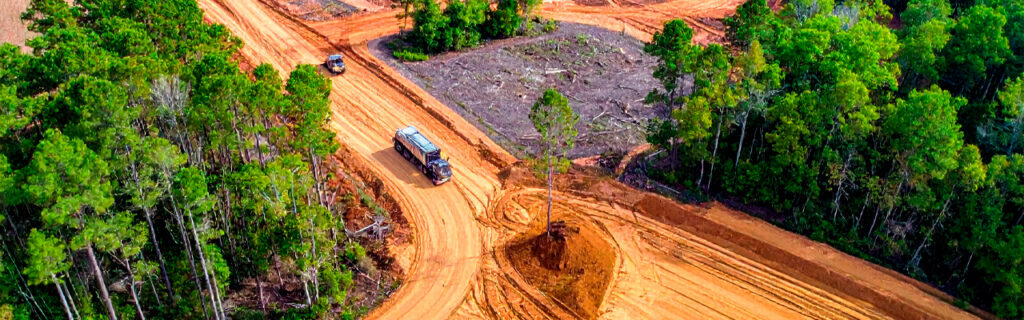
Full clearing removes not only above-ground vegetation but the stumps and root systems of trees and shrubs within the clearing area, typically through bulldozing that uproots and pushes the vegetation including its root systems to piles for burning or removal, through excavation that removes stumps individually, or through stump grinding that converts stumps to below-grade wood chips that eventually decompose. Full clearing produces a site condition with the organic material including root systems removed from the clearing area, the soil surface significantly disturbed by the equipment operations required to remove roots and stumps, and in most cases bare mineral soil exposed across the cleared area rather than the mulch layer that light clearing’s in-place processing deposits. The site condition that full clearing produces is appropriate for subsequent uses requiring complete organic material removal from the subgrade, but it also requires erosion control immediately after clearing to prevent topsoil loss from the exposed bare soil surface before subsequent improvements or vegetation reestablishment can protect it.
How Intended Subsequent Use Determines Clearing Depth Required
The most reliable criterion for determining whether a specific property situation requires light clearing or full clearing is the intended subsequent use of the cleared area, because different subsequent uses have different site condition requirements that only certain clearing approaches can produce. Evaluating the clearing need against the intended subsequent use removes the ambiguity that evaluating against current vegetation conditions alone creates, because the same vegetation conditions may warrant light clearing for one intended use and full clearing for a different intended use of the same area.
Subsequent Uses That Require Full Clearing
Building site development requires complete organic material removal from the building footprint including all stumps and root systems before the structural subgrade preparation that supports the foundation can be correctly executed. Organic material left in the subgrade beneath structural fill continues decomposing after burial and creates the settlement voids that produce foundation movement, floor level variation, and structural distress as the organic material disappears below the placed fill. This organic removal requirement cannot be met by light clearing that leaves root systems in place, making full clearing with stump and root removal the required approach for building site preparation regardless of the vegetation’s current above-ground density or stem size.
Pasture and hay field development requires not only complete canopy removal for adequate sunlight to the ground surface throughout the intended production area but also stump and root removal that allows uniform seedbed preparation and hay harvest equipment operation across the full area without stump obstacles that would damage equipment or create irregular surface conditions incompatible with consistent mowing operations. Light clearing that leaves stumps in place produces a site where pasture seeding and hay mowing are impractical because the stumps obstruct the equipment operations both require, making full clearing with stump removal the required approach for these agricultural conversion uses.
Driveway and road construction through previously vegetated areas requires removal of the root systems that would otherwise create irregular bearing conditions in the driveway subgrade and that would continue growing into and lifting the road surface as they increase in diameter after construction. Root systems left in place beneath a driveway subgrade create the progressive surface heaving, cracking, and irregularity that driveway surfaces above root zones consistently develop as the remaining root systems grow in diameter and lift the surface material above them.
Subsequent Uses That Are Well Served by Light Clearing
Hunting land understory management that aims to open wooded sections to navigable access and functional sight lines while preserving the mature canopy above the understory is the application where light clearing through forestry mulching is specifically and decisively superior to full clearing. The mature canopy that the hunting land manager wants to preserve over the cleared understory is incompatible with the bulldozing approach that full clearing requires, because bulldozing that is necessary to remove root systems would damage or destroy the canopy trees that the management is specifically trying to protect. Light clearing through forestry mulching removes the invasive understory at the soil surface level without disturbing the root systems and soil profile that support the preserved canopy, producing the open woodland floor beneath preserved canopy that hunting land management requires and that full clearing would eliminate along with the invasive species it was intended to address.
Trail and access corridor establishment through wooded terrain requires removing the vegetation that occupies the corridor width to the passable standard the trail’s intended use requires, without disturbing the adjacent woodland that the trail passes through and that provides the wooded character that makes trail walking and ATV travel through the wooded sections desirable. Light clearing that processes corridor vegetation while leaving the adjacent woodland’s root systems and soil profile intact accomplishes this corridor establishment without the soil disturbance and adjacent woodland impact that full clearing approaches would create in the corridor vicinity.
Food plot margin management that restores the food plot’s intended area by removing invasive species that have advanced into the margins from the surrounding woodland does not require full clearing with root removal in the food plot margin because the food plot’s subsequent use as a planted area is not compromised by the root systems that light clearing leaves in the soil. The food plot will be seeded and managed for surface plant production that does not depend on complete root system removal from the margin soil, making light clearing that removes the above-ground competition while leaving root systems in place entirely adequate for this food plot management application.
Subsequent Uses Where Either Approach May Be Appropriate
Food plot establishment from scratch on a site that currently has no productive planting can be accomplished through either light clearing followed by tillage that incorporates the surface mulch and manages the residual root competition, or through full clearing that removes roots from the food plot soil before seeding. The appropriate approach depends on the food plot’s intended planting species, the density and species composition of the existing vegetation that needs to be removed, and the property owner’s preference for the seedbed preparation method they will use. Full-sun food plots requiring complete canopy removal benefit from the more thorough subgrade cleanup that full clearing provides. Smaller food plot areas with less intensive vegetation and less demanding seedbed requirements can often be established successfully through light clearing followed by appropriate seedbed preparation and competitive management of the residual root resprout during the establishment season.
How Current Vegetation Conditions Affect Approach Selection
While intended subsequent use is the primary criterion for clearing approach selection, the current vegetation conditions in the clearing area affect the practical choices available for both light clearing and full clearing and should be assessed as part of the evaluation that produces the clearing approach recommendation for any specific situation.
Vegetation Density and Stem Size
The current density and stem size of vegetation in the clearing area determines which light clearing equipment and methods can effectively process it and what the full clearing operation’s scope and cost will be. Light clearing through standard brush mowing is appropriate for herbaceous growth and light woody stems within the mowing equipment’s processing capacity. Light clearing through forestry mulching is appropriate for the woody stem densities and stem diameters that exceed mowing equipment capacity but fall within the forestry mulching machine’s processing range. Full clearing through bulldozing and excavation is appropriate and efficient for the large tree diameters and dense root systems that require the pushing and grubbing force that excavation equipment provides. Assessing the current vegetation’s density and maximum stem size gives the information needed to determine which clearing equipment can effectively process what is present, which is the practical constraint that affects clearing approach selection alongside the intended subsequent use criterion.
Presence of Preservation Targets Within the Clearing Area
The presence of significant trees, native species, and natural features within the clearing area that the property owner wants to preserve affects clearing approach selection because full clearing methods that are efficient for complete vegetation removal cannot be applied selectively in ways that protect specific preservation targets within the clearing area as effectively as the light clearing methods that are specifically designed for selective application. If the clearing area contains significant mature trees or native understory species that should be preserved, light clearing through forestry mulching provides the selective application capability that allows the operator to process invasive species and overgrowth while navigating around preservation targets. Full clearing approaches including bulldozing are less compatible with preservation targets within the clearing area because the equipment’s operation mode is less precisely controllable in close proximity to standing trees than forestry mulching equipment’s directed cutting head.
Terrain and Slope Conditions
Slope conditions in the clearing area affect the erosion risk associated with different clearing approaches and should inform the approach selection for areas where slope makes the bare soil exposure from full clearing significantly more erosion-vulnerable than the soil-protective mulch layer that light clearing deposits. Full clearing on slopes above approximately fifteen percent gradient exposes bare mineral soil that North Georgia’s high-intensity summer rainfall events can erode significantly before revegetation or erosion control measures establish adequate surface protection. Light clearing on the same slopes leaves both the root systems of cleared vegetation and a surface mulch layer that together provide substantially better erosion protection than full clearing’s bare soil exposure. For clearing areas on significant slopes where the intended subsequent use can be served by light clearing, the erosion protection advantage of light clearing’s in-place processing is a practical reason to prefer it over full clearing that would achieve equivalent above-ground vegetation removal at higher erosion risk and higher remediation cost if the bare slopes experience the significant erosion that North Georgia’s rainfall frequently initiates on unprotected disturbed soil.
How to Conduct a Property Assessment to Determine Clearing Needs
A productive clearing needs assessment for a specific property and clearing area covers four evaluation categories that together produce the clearing approach recommendation appropriate for the specific situation. Conducting this assessment before engaging contractors or committing to a clearing approach allows the approach selection to be deliberate rather than defaulting to either the most comprehensive or the most minimal option without specific evaluation of what the situation requires.
The first category is intended subsequent use. Defining specifically what the cleared area will be used for after clearing is complete, at the level of specificity needed to apply the subsequent use criteria described earlier in this article, establishes the foundational requirement that the clearing approach must satisfy. This definition should be made before the vegetation assessment because the subsequent use determination establishes the site condition requirement that the clearing approach must produce, against which the vegetation conditions and terrain characteristics are then evaluated for how they affect the means of achieving that required site condition.
The second category is vegetation inventory. Walking the clearing area specifically to assess the current vegetation density, the maximum stem sizes present, the species composition, and the presence of any preservation targets that should be retained within the clearing area gives the vegetation information that clearing method capability must be evaluated against. Noting specifically whether the dominant invasive species are herbaceous or woody, whether woody stems are within brush mowing capacity or require forestry mulching or chainsaw work, and whether any significant trees or valuable native species within the area warrant preservation provides the vegetation context that clearing method selection requires.
The third category is terrain assessment. Estimating the slope of the clearing area at its steepest sections and noting any drainage features, wet areas, or natural terrain characteristics that should be specifically considered in clearing approach selection gives the terrain context that affects erosion risk evaluation and equipment access assessment.
The fourth category is contractor assessment with the combined information from the first three categories. Presenting the subsequent use definition, vegetation inventory, and terrain assessment to an experienced local contractor with knowledge of Cherokee County clearing conditions produces the clearing approach recommendation that combines the property owner’s specific situation knowledge with the contractor’s regional experience and clearing method expertise. This combined assessment consistently produces better approach selections than either the property owner’s assessment alone without contractor input or the contractor’s assessment without the property owner’s specific subsequent use definition and preservation priorities.
Common Situations and the Clearing Approach That Typically Serves Them
The following common clearing situations on Cherokee County residential and rural properties illustrate how the subsequent use, vegetation, and terrain criteria apply to produce the clearing approach recommendation for each specific situation.
- Invasive understory removal beneath preserved canopy for hunting land management: Light clearing through forestry mulching is the appropriate approach because the subsequent use requires preserved canopy, the invasive understory is the target and the canopy trees are preservation targets, and light clearing’s selective application capability specifically supports canopy preservation while processing invasive growth.
- Building site preparation on a wooded lot: Full clearing with stump and root removal is required because the subsequent use, building foundation construction, requires complete organic material removal from the subgrade that light clearing cannot accomplish while leaving root systems in place.
- Trail corridor establishment through wooded terrain: Light clearing through forestry mulching is the appropriate approach because the subsequent use requires accessible corridor width without disturbing the adjacent woodland, and forestry mulching processes corridor vegetation while leaving the adjacent woodland intact.
- Pasture development from wooded land: Full clearing with stump removal is required because the subsequent use, pasture with regular mowing operations, requires a stump-free surface that light clearing cannot provide while leaving stumps in place.
- Fence line corridor restoration with vegetation integration in fence infrastructure: Light clearing through forestry mulching is the appropriate approach because the subsequent use requires accessible fence line corridor and infrastructure inspection access, preservation of any canopy trees along the boundary is typically desired, and forestry mulching can process vegetation from fence corridors with adequate precision for the infrastructure protection that fence line clearing requires.
- Residential yard expansion into adjacent wooded area with preservation of significant trees: Light clearing through forestry mulching is the appropriate approach when specific mature trees within the expansion area should be preserved, because light clearing’s selective capability allows those trees to be preserved while the invasive and brushy growth between them is removed to create the expanded usable yard area.
Frequently Asked Questions
Can a clearing project use both light and full clearing methods in different areas of the same project?
Yes, and combining light and full clearing in different areas of the same project is often the approach that best serves properties where different sections have different intended subsequent uses requiring different clearing depths. A rural property project that includes building site preparation in one section, trail corridor establishment through an adjacent wooded section, and food plot development in a third area might appropriately use full clearing with stump removal for the building site, forestry mulching for the trail corridors, and either approach for the food plots depending on their specific seeding requirements. Planning the clearing approach for each section of the project area independently against the subsequent use and vegetation criteria described in this article produces a clearing plan that uses each method where it is appropriate rather than applying either a uniform full clearing or uniform light clearing approach to all sections regardless of their different requirements.
How does the age and establishment history of invasive vegetation affect whether light clearing or full clearing is needed?
The age and establishment history of invasive vegetation affects clearing approach selection primarily through its impact on stem size and root system depth rather than through independent criteria that would override the subsequent use evaluation. Older, more established invasive populations have larger stem diameters and deeper root energy reserves that affect the clearing method required to process the above-ground growth and the herbicide follow-up intensity needed to deplete the root energy that mechanical clearing alone does not address. But the fundamental question of whether light clearing or full clearing is appropriate for the specific situation remains determined by the intended subsequent use rather than by how old the invasive population is. Twenty-year-old privet that has developed to eight-inch stem diameters in a hunting land understory still warrants light clearing rather than full clearing if the intended subsequent use is hunting land management with canopy preservation, because the clearing approach requirement is a function of what the cleared area needs to become rather than how large or old the vegetation being cleared has grown.
What does light clearing cost compared to full clearing on a per-acre basis in Cherokee County?
Light clearing through forestry mulching and full clearing with stump removal are priced differently per acre because they require different equipment, different operating time per acre, and produce different site conditions with different debris management implications. Forestry mulching for light clearing typically costs less per acre than full clearing with stump removal because the in-place processing that mulching accomplishes eliminates the debris piling, hauling, or burning operations that full clearing requires to manage the material the bulldozing operation produces. Full clearing costs more per acre when it includes stump grinding or mechanical root removal that requires additional equipment time beyond the initial bulldozing pass. The specific cost difference for any given clearing situation depends on the vegetation density and stem sizes involved, the acreage scale of the project, the terrain and access conditions at the site, and the specific contractor’s pricing for each method. Getting separate quotes for both approaches from an experienced local contractor, with clear description of the intended subsequent use that determines which approach is actually appropriate for the situation, gives the most accurate cost comparison for the specific clearing situation rather than generic per-acre estimates that may not reflect the actual conditions at the property being evaluated.
Is there a vegetation density or stem size below which professional clearing equipment is not needed and owner-operated equipment can address the clearing need?
Owner-operated brush mowing with a tractor-mounted rotary mower or bush hog is adequate for clearing herbaceous growth, grasses, and light woody stems approximately up to one inch in diameter in areas where the vegetation density is within the equipment’s processing capacity and where the terrain allows safe mower operation. Below these density and diameter thresholds, professional clearing equipment mobilization is generally not required for the mechanical clearing phase, though herbicide follow-up treatment of invasive resprout after owner-operated mowing is still the management action that prevents the cleared area from returning to limiting density within the current growing season. Above these thresholds, professional forestry mulching or chainsaw work is needed because the stem diameters and densities involved exceed what standard rotary mowing equipment can safely and effectively process. The assessment of whether the specific clearing area’s vegetation is within or above owner-operated equipment capacity should be made from a physical inspection of the actual vegetation conditions rather than from a general description of the property, because vegetation density and stem size vary significantly across different sections of the same property depending on how long different areas have gone without management.
Ready to Determine the Right Clearing Approach for Your Property?
The clearing approach that serves your specific property situation is determined by what the cleared area needs to become rather than by how much vegetation is currently occupying it. Evaluating the intended subsequent use of the clearing area against the site condition requirements that different subsequent uses create, assessing the current vegetation conditions and terrain characteristics against those requirements, and engaging an experienced local contractor with Cherokee County clearing knowledge to translate that combined information into a specific approach recommendation produces the clearing scope and method that serves your situation without overcorrection that costs more than needed or undercorrection that proves inadequate for the use you intend. Both light clearing and full clearing are the right answer in the right situation, and the evaluation that determines which situation you have is the planning investment that makes the clearing you commission produce the outcome you actually need.
Bardin Outdoors works with property owners across Ball Ground, Canton, Cherokee County, and North Georgia on land clearing and forestry mulching projects matched to the specific clearing depth that each property situation requires, from selective understory clearing that preserves canopy character to full site clearing that prepares land for building and agricultural development. To learn more about how Bardin Outdoors can help determine and execute the right clearing approach for your property, contact us.