For property owners across Cherokee County, Ball Ground, and Canton planning clearing projects on their residential and rural lots where the choice between forestry mulching and traditional clearing methods determines the site condition, the ecological outcomes, the soil preservation, and the cost efficiency that the clearing investment produces, understanding the specific conditions and intended uses that make forestry mulching the better choice and those that make traditional clearing the better choice gives the practical knowledge for selecting the method that serves the specific project’s requirements rather than defaulting to either method universally regardless of what the specific situation actually calls for.
Understanding What Each Method Produces and Why the Difference Matters
Before evaluating which method is better for any specific situation, understanding what each method produces in terms of post-clearing site conditions gives the foundation for connecting each method’s specific outcomes to the specific requirements of each clearing situation rather than treating both methods as equivalently producing cleared ground that differs only in cost and approach.
Forestry mulching processes above-ground vegetation at or near the soil surface level, grinding stems and branches into the wood chip and organic material mulch layer that is deposited back onto the cleared surface rather than being pushed, piled, or removed from the site. This processing approach leaves root systems in place beneath the soil surface, preserves the topsoil that the vegetation was growing in, deposits a protective mulch layer over the cleared surface, and can be directed to process invasive and unwanted vegetation selectively while navigating around trees and native species that should be preserved. The post-mulching site condition is accessible open ground with preserved topsoil, a surface mulch layer, intact root systems beneath the surface, and the selective preservation of whatever native trees and species the operator was specifically directed to navigate around.
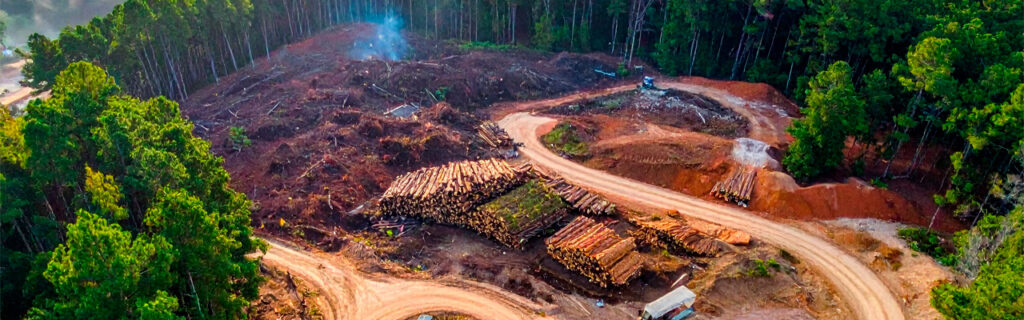
Traditional clearing through bulldozing, scraping, and pile-and-burn or pile-and-haul processing pushes the above-ground vegetation along the ground surface, displacing topsoil along with the vegetation it removes, uprooting root systems as the blade passes through the surface material, and producing either on-site debris piles that require burning or hauling or a cleaned site from which the vegetation and surface material have been completely removed. The post-traditional-clearing site condition is bare mineral subsoil in the areas that the blade’s passing stripped of the organic topsoil layer, with the vegetation and the topsoil that carried it having been pushed to the pile or haul positions. Stump grinding after traditional clearing removes the above-grade stump remnants, and root raking removes the larger root masses that the clearing exposed, producing the organic-clear subgrade that structural site preparation requires.
Conditions That Make Forestry Mulching the Better Choice
Forestry mulching is the better clearing method choice in specific situations where the combination of intended subsequent use, vegetation character, terrain, and access conditions align with the specific outcomes that forestry mulching produces more effectively than traditional clearing would for the same clearing investment.
When Native Canopy Preservation Is a Primary Clearing Objective
Clearing situations where the preservation of native canopy trees above the invasive understory being cleared is a primary objective are the situations where forestry mulching’s selective processing capability produces the specific outcome that the clearing is intended to achieve and that traditional bulldozing cannot produce without damaging or removing the canopy the clearing should specifically preserve. Hunting land understory management that targets invasive privet below the mature oak and hickory canopy, selective clearing of trail corridors through wooded sections that should remain forested, and residential property boundary clearing that should remove invasive understory while preserving the native canopy that provides privacy screening and character are each clearing objectives that forestry mulching’s selective processing serves and that bulldozing’s comprehensive soil-surface-level disturbance cannot serve at the same preservation accuracy. When canopy preservation is the objective, forestry mulching is the better choice not because it is cheaper or faster but because it is the only method among the two that can accomplish the canopy preservation the clearing objective requires while also removing the invasive understory that the clearing is intended to address.
When Topsoil Preservation Matters for Subsequent Use
Clearing situations where the subsequent use of the cleared area depends on the topsoil condition that traditional clearing’s scraping and pushing would degrade or remove favor forestry mulching because its processing approach leaves the topsoil in place rather than displacing it with the vegetation. Food plot establishment that relies on the native topsoil’s fertility and soil structure for productive planting establishment performs better on mulched sites that preserved the topsoil than on traditionally cleared sites where the blade’s passing removed topsoil with the vegetation, exposing the less fertile, less biologically active subsoil as the establishment medium. Pasture seeding on mulched sites benefits from the preserved topsoil’s organic matter and biological activity compared to the compacted, topsoil-depleted subsoil that bulldozing leaves as the seeding medium. And native vegetation recovery from the existing soil seed bank that preserved topsoil makes available to cleared sites is substantially more productive on mulched sites that preserved the seed bank than on bulldozed sites that buried or removed it. When the cleared area’s subsequent use depends on the topsoil condition that the clearing’s approach determines, forestry mulching’s topsoil-preserving processing is the better choice.
When Slope and Erosion Risk Make Bare Soil Exposure Costly
Clearing projects on slopes where the rainfall energy concentration and surface flow velocities that North Georgia’s high-intensity storms produce on bare clay would initiate significant erosion before revegetation or erosion control measures could establish adequate surface protection favor forestry mulching because its processing approach deposits the surface mulch layer that immediately protects the cleared slope from the erosion that traditional clearing’s bare mineral soil exposure would experience during the establishment period. Traditional clearing on significant slopes that requires erosion control mat installation, seeding, and mulch placement to protect the cleared surface during the establishment period after clearing adds the erosion control scope and cost to the clearing project that forestry mulching’s in-place processing eliminates by depositing the protective mulch layer during the clearing rather than requiring it as a subsequent erosion control installation. When slope conditions make erosion control a significant clearing project cost component, forestry mulching’s combined clearing and erosion control through its in-place processing frequently produces the lower total project cost and the better erosion protection outcome than traditional clearing plus separate erosion control measures would produce for the same clearing objective.
When Access Constraints Limit Equipment Size
Clearing projects in areas that access constraints limit to the equipment sizes that can navigate the access route to the clearing area may favor forestry mulching over traditional clearing when forestry mulching equipment can navigate the access constraints that the bulldozer and grader combination that traditional clearing requires cannot. Forestry mulching machines have specific dimensional envelopes that may fit through gate openings, navigate corridor widths, and operate on terrain grades that traditional clearing equipment’s larger footprint and different stability requirements cannot accommodate. When access constraints limit the equipment options that can reach the clearing area, the clearing method that those accessible equipment options support is the method the project must use rather than the method that the property owner might otherwise prefer, which on access-constrained Cherokee County rural properties often means forestry mulching equipment reaching areas that bulldozing equipment cannot access through the same route.
When Debris Management Cost Is a Primary Budget Consideration
Traditional clearing on larger vegetation or denser stands produces debris volumes that require either on-site burning, which requires burn permits and weather conditions that may not be consistently available during the project’s execution window, or debris hauling, which adds transportation cost for each load removed from the site to the clearing cost that the vegetation processing itself requires. Forestry mulching eliminates this debris management cost by processing the vegetation in place, converting the clearing debris to the mulch layer that remains on site rather than requiring the separate management that traditional clearing’s debris production demands. When debris management cost represents a significant fraction of the traditional clearing project’s total cost, the comparison between traditional clearing plus debris management and forestry mulching at its all-in cost frequently favors forestry mulching on the basis of total project cost rather than only on the soil preservation and selective clearing advantages that favor it in other situations.
Conditions That Make Traditional Clearing the Better Choice
Traditional clearing through bulldozing and organic removal is the better clearing method choice in specific situations where the combination of intended subsequent use and required site conditions align with what traditional clearing produces more effectively than forestry mulching would for the same clearing investment.
When Complete Organic Removal Is Required for Structural Use
Building site preparation that requires complete removal of all organic material from the structural subgrade zone, including root systems that would otherwise decompose beneath structural fill and create the settlement voids that organic decomposition produces in the structural zone, cannot be accomplished through forestry mulching that leaves root systems in place beneath the soil surface. Traditional clearing with stump removal, root raking, and the organic stripping that produces an organic-free mineral subgrade is the method that structural building site preparation requires, and forestry mulching’s root-preserving processing approach is specifically inadequate for this application regardless of how well it serves other clearing objectives. When the structural site preparation that building foundations, driveway subgrades, and compacted fill areas require is the clearing objective, traditional clearing with complete organic removal is the method that the structural requirements specify rather than an alternative that cost or preference considerations can substitute with forestry mulching without compromising the structural performance the preparation is intended to achieve.
When Large-Diameter Trees Exceed Mulching Equipment Capacity
Forestry mulching equipment has a maximum stem diameter processing capacity that varies by machine size but that limits the range of tree sizes the equipment can process without exceeding the machine’s designed operating parameters. Large-diameter trees at the upper end of or above the machine’s processing capacity require the chainsaw cutting and pushing or skidding removal that traditional clearing methods use for trees of any size, making traditional clearing or a hybrid approach using chainsaw felling followed by mulching of the smaller vegetation more appropriate than mulching alone for sites where the large-diameter trees that exceed mulching capacity are a significant component of the clearing scope. When a clearing project includes a meaningful proportion of large-diameter trees at or above the mulching equipment’s processing capacity, the practical approach is the hybrid that chainsaw fells and removes the large-diameter trees while the mulching equipment processes the remaining understory and smaller tree populations that fall within its processing range.
When Stump-Free Surface Is Required for Hay Harvest Equipment
Hay field development from wooded or brushy land that requires a stump-free operating surface for hay mowing, conditioning, and tedding equipment needs the stump removal that traditional clearing with stump grinding or root raking provides rather than the above-ground processing that forestry mulching accomplishes while leaving stumps at or near the soil surface in conditions that hay harvest equipment contact risk makes unacceptable. Forestry mulching that grinds smaller diameter stems to the soil surface level addresses the smaller-stem portion of the hay field clearing requirement but may not achieve the stump heights below hay equipment’s operating clearance that larger-diameter stump processing requires, making traditional clearing with comprehensive stump management the more appropriate method for hay field applications where the equipment operating clearance requirement creates the stump-free surface standard that the clearing method must achieve throughout the full hay field extent.
When a Combined Approach Serves the Clearing Objective Best
Many clearing projects on Cherokee County rural properties are not cleanly matched to either forestry mulching alone or traditional clearing alone but rather to a combined approach that uses each method where its specific capabilities best serve the specific clearing requirements at each portion of the project area. This combined approach is not a compromise between the two methods but the optimal application of each method to the portion of the clearing scope where it produces the best outcome.
A rural property project that includes a building site, a food plot, and trail corridors through wooded sections appropriately uses traditional clearing with organic removal and structural subgrade preparation for the building site, forestry mulching for the food plot establishment where topsoil preservation serves the planting, and selective forestry mulching for the trail corridors where canopy preservation and minimal soil disturbance serve the wooded character the trails should preserve. Each method is applied to the clearing scope where its specific capabilities align with the specific requirements, producing the best outcome for each portion of the project rather than applying a single method universally and accepting its limitations for the portions where the alternative would have served better.
A clearing project where large-diameter trees must be removed from a section that will then be managed as selective open woodland appropriately uses chainsaw felling to remove the large-diameter trees that exceed forestry mulching equipment capacity, then forestry mulching to process the invasive understory and smaller vegetation surrounding the previously felled large trees while preserving the native understory species that the hunting land management intends to keep. This sequenced combination produces the selective woodland clearing outcome that neither chainsaw clearing alone nor mulching alone would accomplish as completely as the sequenced combination that applies each tool where its capabilities are most relevant to the clearing objective at each stage.
How to Evaluate Which Approach Your Specific Clearing Project Requires
Evaluating which clearing approach a specific project requires involves answering the specific questions that distinguish the clearing situations that favor forestry mulching from those that favor traditional clearing or a combined approach. The most consequential questions are the intended subsequent use of the cleared area, whether significant native canopy should be preserved during clearing, whether the subsequent use requires organic-free structural subgrade preparation, and whether slope conditions or access constraints create a practical constraint on equipment selection that determines the available method options independent of preference considerations.
Property owners who are uncertain which approach is most appropriate for their specific clearing project benefit most from presenting the specific clearing objectives, the intended subsequent use, and the site conditions to a contractor experienced with both methods on Cherokee County rural properties, because the contractor’s regional project experience with both methods allows them to connect the specific clearing conditions and objectives to the specific method capabilities in ways that accurately predict the outcome each method would produce for the specific project rather than presenting the clearing decision as a preference between equivalent alternatives that produce the same outcome through different processes. The method that produces the best outcome for the specific project at the specific site is the method that the site-informed contractor recommendation should identify from the site-specific conditions rather than the method that the property owner selects from general preferences without the site-specific assessment that accurate method selection requires.
Frequently Asked Questions
Is forestry mulching always more expensive than traditional clearing on a per-acre basis?
Forestry mulching is not always more expensive than traditional clearing on a per-acre basis when the total project cost comparison accounts for all the scope components that each method’s clearing requires rather than only the clearing operation’s direct cost. Traditional clearing that produces debris requiring burning or hauling adds the debris management cost to the clearing operation’s direct cost that forestry mulching’s in-place processing eliminates. Traditional clearing on slopes that requires subsequent erosion control mat installation and seeding adds the erosion control scope cost that forestry mulching’s surface mulch deposit reduces or eliminates. And traditional clearing that requires stump grinding adds the stump management cost to the overall clearing project that forestry mulching’s processing-to-grade approach may partially address depending on the stem diameters being processed. When these total project cost comparisons are made for specific clearing situations that generate significant debris management, erosion control, and stump management costs in traditional clearing, forestry mulching frequently produces equivalent or lower total project costs rather than the higher cost that the clearing operation’s direct cost alone might suggest.
Can forestry mulching be used to maintain areas that were originally cleared by traditional methods?
Yes, and maintenance clearing of areas originally established through traditional clearing methods is one of the most common forestry mulching applications on Cherokee County rural properties because the resprout growth and new invasive establishment that accumulate in cleared areas between maintenance events are precisely the vegetation densities and stem sizes that forestry mulching equipment processes most efficiently. Areas that were originally bull dozed and cleared comprehensively are often best maintained through forestry mulching of the resprout and new growth that subsequent seasons produce because the maintenance clearing objective is removing the above-ground vegetation that has accumulated since the last clearing without the comprehensive organic removal and structural subgrade preparation that the original clearing required but that maintenance clearing of resprout in an already-cleared area does not need. The method that is most appropriate for initial site establishment and the method most appropriate for subsequent maintenance clearing of that establishment are not necessarily the same method, and the area that required traditional clearing for initial structural site preparation is often best maintained through forestry mulching that efficiently addresses the maintenance vegetation without the unnecessary scope of repeated structural subgrade preparation that the already-prepared site does not need.
How does the density of the existing vegetation affect the choice between forestry mulching and traditional clearing?
Vegetation density affects the choice between forestry mulching and traditional clearing primarily through its effect on the relative processing efficiency of each method at the specific density and stem size that the clearing project presents. Forestry mulching equipment processes most efficiently at the stem diameters and densities that established Cherokee County invasive species populations most commonly present after two to five seasons of unchecked growth, which is typically within the one to six inch stem diameter range at moderate to high density that the mulching machine’s cutting head and processing drum are designed to address at high production rates. Traditional clearing through bulldozing is most efficient at the stem sizes and densities that exceed the mulching machine’s processing capacity, specifically large-diameter trees and dense root masses that the bulldozer’s pushing force addresses more efficiently than the cutting and grinding approach that mulching uses. Very light vegetation density at small stem sizes may be most efficiently addressed by owner-operated brush mowing equipment rather than either professional method, because the vegetation density and stem development may not justify the mobilization cost of professional equipment for the processing volume that the low-density vegetation presents.
Does the time of year affect whether forestry mulching or traditional clearing is the better choice?
Time of year affects both methods’ operational efficiency and some site condition outcomes rather than fundamentally changing which method is more appropriate for the clearing objective, but the seasonal effects on each method are different enough that they can influence the final method selection when other factors do not clearly favor one method over the other. Forestry mulching is most operationally efficient during late fall and winter dormancy when the above-ground biomass of deciduous vegetation is lowest, the leafless understory allows preservation targets to be identified more accurately within the treatment area, and the dormant-season timing positions the treated site for the spring herbicide follow-up timing that resprout management most efficiently captures. Traditional clearing is most operationally feasible during the same late fall to early spring period when clay soil moisture conditions are more likely to be within the range that supports heavy equipment operation without the severe ground disturbance that saturated clay under heavy equipment loading produces during the wet spring conditions that both methods should avoid for different operational reasons. The primary seasonal factor that influences method selection is the herbicide follow-up timing opportunity that late-summer mechanical treatment creates for same-season resprout management, which favors forestry mulching in the late-summer treatment window specifically because the active growing conditions that follow late-summer treatment enable the most efficient herbicide treatment timing that root energy depletion from the combined program requires to produce progressive management improvement toward the sustainable maintenance condition.
Ready to Determine the Right Clearing Approach for Your Property?
The clearing method that produces the best outcome for your specific North Georgia property clearing project is the method whose specific capabilities align most closely with the specific requirements of your clearing situation: the intended subsequent use, the vegetation character and density, the terrain and access conditions, and the soil and ecological outcomes that the clearing area’s long-term productivity requires. Forestry mulching and traditional clearing are each superior to the other in the specific situations where their respective capabilities best serve the specific requirements, and a combined approach frequently produces the best total project outcome by applying each method where it contributes most effectively to the full clearing objective rather than applying a single method universally. Evaluating your specific clearing situation against the method-selection factors described in this article, and presenting that evaluation to an experienced local contractor who has executed both methods on Cherokee County properties, produces the method recommendation that serves your specific project rather than the generic preference that serves no project specifically.
Bardin Outdoors works with property owners across Ball Ground, Canton, Cherokee County, and North Georgia on forestry mulching and land clearing projects matched to the specific clearing method that each property’s conditions and intended use require, applying the regional project experience that connects specific clearing conditions to the method capabilities that serve them most effectively. To learn more about which clearing approach is right for your specific North Georgia property project, contact us.