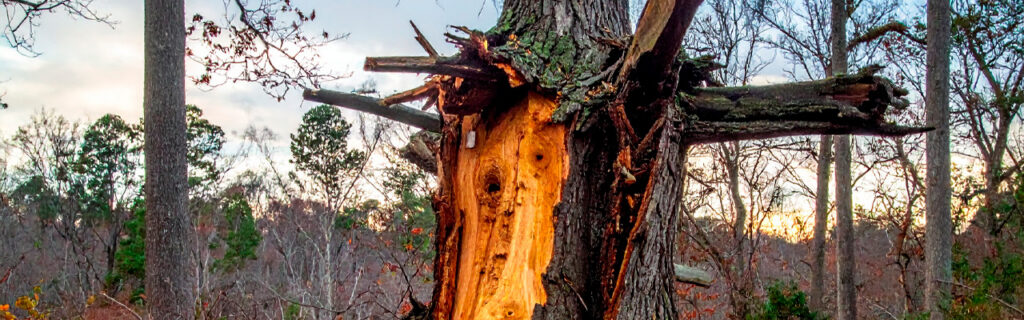
For property owners across Cherokee County, Ball Ground, and Canton with damaged trees near their homes, outbuildings, and regularly used outdoor areas, understanding how tree damage progresses when left untreated changes the decision framework for responding to identified tree concerns from a question of whether to act to a question of when to act and at what cost. The answer to that timing question is almost always that earlier action produces better outcomes at lower cost than deferred action on a condition that has been progressing without intervention. This article addresses the specific mechanisms through which damaged trees deteriorate when untreated, what that deterioration looks like at different stages, and what the escalating consequences of deferred intervention are for property safety and management cost.
How Tree Damage Initiates a Progressive Deterioration Process
Tree damage, regardless of its cause, initiates a biological response and a physical deterioration process that continue interacting with each other over time in ways that progressively change the tree’s structural condition. Understanding this process explains why a damaged tree left untreated does not simply remain in its damaged condition but moves through a predictable progression toward conditions that are more dangerous and more difficult to address than the original damage was.
When a tree is wounded, it responds through compartmentalization, a biological defense mechanism that attempts to isolate the damaged tissue from the surrounding healthy wood. Compartmentalization is not healing in the way that animal tissue heals. It does not remove the damaged wood or restore it to its original structural condition. It creates a boundary around the damaged area within which the compromised tissue is isolated but continues to deteriorate. The speed and completeness of compartmentalization varies by species, tree age, and the tree’s overall health at the time of the wound. Strong compartmentalisers including oaks and hickories resist internal decay spread more effectively than weak compartmentalisers. But no tree prevents all internal decay advance at all wound sites, and the compartmentalized zones within any previously wounded mature tree contain progressively larger areas of deteriorating wood the longer those wounds have been present and advancing without external intervention to remove the most severely compromised structural material.
How Internal Decay Advances in Untreated Damaged Trees
Internal decay within a compartmentalized wound zone progresses through the action of decay fungi that colonize the compromised wood tissue once the wound provides the entry point that healthy bark normally prevents. These fungi break down the cellulose and lignin that give wood its structural strength, converting structural heartwood and sapwood into soft, friable material that provides progressively less resistance to the bending and compression forces that wind, ice, and the tree’s own canopy weight apply to the trunk and major branches containing the decay zone.
The rate of decay progression varies with the species of decay fungus involved, the moisture conditions within the affected zone, the temperature and seasonal patterns of the local environment, and the amount of structural wood the decay organism has available to consume. Under North Georgia’s warm, moist climate conditions that favor active fungal growth through much of the year, decay progression in established wound zones is meaningfully faster than in cooler, drier climates. A decay zone that would require many years to progress to structurally significant size in a northern climate may reach the same structural significance in fewer years in Cherokee County’s conditions, which is why the monitoring intervals and intervention timelines appropriate for damaged trees in other regions may be inadequate for managing the same conditions in North Georgia.
As the decay zone expands within the trunk or branch, the cross-sectional area of sound wood resisting structural loads decreases proportionally. The tree’s structural capacity at any cross-section where decay is present is determined by the thickness of the remaining sound wood shell surrounding the decay zone rather than by the total cross-sectional diameter of the trunk or branch at that location. A large-diameter trunk can accommodate a substantial internal cavity while retaining adequate structural capacity if the remaining sound wood shell is thick relative to the total diameter. The same cavity in a smaller-diameter trunk or in a trunk where the sound wood shell has been reduced by multiple decay zones leaves proportionally less structural material to resist wind loading and canopy weight, creating conditions where failure is possible at wind speeds that the same tree would have resisted without difficulty before the decay reduced its structural capacity.
How Storm Damage Worsens When Underlying Conditions Go Unaddressed
Storm-damaged trees that have sustained partial branch failures, bark stripping, root plate disturbance, or crown damage present conditions that create additional risk beyond what the visible storm damage itself represents if they are left without assessment and appropriate response. The storm damage that is visible, a broken branch hanging in the crown, bark stripped from a trunk section, a lean that appeared after the storm passed, is the part of the tree’s condition change that produced a recognizable alert. The response to that visible alert determines whether the tree’s condition is assessed and managed appropriately or whether the visible damage is treated as the full extent of the condition while the underlying structural changes the storm may have initiated progress without recognition.
Hanging Branch Deterioration
A branch that was partially broken by storm loading and remains hanging in the crown, attached to the tree by whatever wood fibers the storm did not sever, dries progressively through the weeks and months following the storm event that created the partial failure. As it dries, its flexibility decreases and its brittleness increases, making it more likely to fail under subsequent wind loading that its still-living equivalent would have survived. The partial attachment point sustaining it is not healing. It is weakening as the separated wood at the break point loses the moisture that maintained its residual fiber strength and as decay organisms access the wound at the break site and begin deteriorating the surrounding wood. A hanging branch that was a manageable pruning job when it was first identified becomes progressively more dangerous and more difficult to remove safely as its condition advances through this drying and decay process.
Bark Damage and Exposed Wood Deterioration
Bark stripped from a trunk by storm debris, equipment contact, or other mechanical damage creates an exposed wood wound that is immediately accessible to the decay fungi that healthy intact bark normally excludes. The exposed wood dries on its outer surface but retains moisture within, creating the conditions that wood-rotting fungi favor for establishment. In the first season following bark damage, the wound may appear stable and even show callus tissue forming at its margins as the tree attempts to grow bark over the wound. Within the wound, however, decay fungi may already be establishing in the exposed wood, and the callus tissue forming at the margins does not necessarily prevent the decay within from advancing toward the wood beneath it.
Bark damage wounds that are not addressed through assessment of their extent and depth, and that are not monitored for the fungal activity that may indicate establishing decay, can develop internal decay behind an intact-appearing wound margin over several seasons without any external indication of what is occurring within. When fungal fruiting bodies eventually appear at the wound site, they are confirming that the decay they represent has been progressing internally for the full period since establishment, which on a wound left without monitoring may be several years before any visible surface evidence appears.
Root System Disturbance and Anchoring Compromise
A tree that has shown any change in lean or soil movement at its base following a storm event has experienced root plate disturbance that may or may not represent immediate structural failure risk depending on the extent of the root system disruption. Root plate disturbance that is not assessed after a storm event leaves a condition of unknown severity that the next storm’s saturated soil and wind loading will test without any prior determination of whether the root anchoring remaining after the disturbance is adequate to resist that test. Root plate movement that was relatively minor after the first storm becomes progressively more significant if each subsequent storm advances the displacement further, and the cumulative root anchoring loss from multiple incremental storm events may eventually produce a total anchoring failure without any single event that would have flagged the tree as an immediate emergency if each event had been observed in isolation.
How Disease-Related Damage Progresses When Untreated
Certain tree health conditions including vascular wilt diseases, canker diseases, and root rots are progressive in ways that make early identification and response consequential for the tree’s survival and for the safety of property features within its fall zone. These conditions do not stabilize without intervention and in many cases cannot be reversed once they have advanced beyond their early stage, making the timing of their identification and the promptness of the response to their identification the factors that determine whether the affected tree can be managed toward a stable condition or whether it will continue declining toward the failure threshold that removal would have addressed more predictably if undertaken before that threshold was reached.
Vascular wilt diseases including oak wilt and various fungal wilts block the water and nutrient transport through the tree’s vascular system in specific pathways, producing the localized wilting, crown dieback, and premature leaf loss that distinguishes vascular disease from general decline. Once established, these diseases spread through the root connections between adjacent trees of susceptible species and through above-ground transmission vectors, meaning that a diseased tree left untreated continues infecting adjacent susceptible trees in addition to continuing its own decline. Early identification and response including removal of the infected tree and appropriate management of root connections to adjacent susceptible trees limits the spread that deferred response allows to extend to a larger number of trees in the surrounding stand.
How the Consequence of Failure Escalates as Damage Progresses
As a damaged tree’s structural condition deteriorates over time without intervention, two things change simultaneously: the probability of failure under any given wind or ice loading event increases as structural capacity declines, and the consequence of failure may increase as the canopy continues growing and adding mass to the material that would fall in a failure event. A large old oak with advancing internal decay is not producing less canopy as its structural wood quality declines. It is potentially producing more canopy as the living portions of the tree continue adding annual growth to the canopy mass that the compromised structural wood must support and that would fall in a failure event.
The combination of declining structural capacity and potentially increasing canopy mass is what makes mature trees with advancing internal decay particularly consequential when their fall zone includes structures and occupied areas. The failure event that a tree’s compromised structural condition eventually produces involves canopy mass proportional to the tree’s full growth history, not proportional to its structural wood quality at the time of failure. This is why large mature trees with advanced internal decay near structures represent the highest-consequence category of tree hazard on residential and rural North Georgia properties, and why the response to identified decay conditions in these trees should be scaled to the consequence of their potential failure rather than to the current visual appearance of what is still standing.
How Removal Cost and Complexity Increase as Damage Advances
Beyond the structural safety progression that untreated tree damage produces, the practical cost and complexity of professional tree removal typically increases as the tree’s condition advances and as the circumstances of its fall zone change over the seasons that the damage was allowed to progress unaddressed. Several specific mechanisms produce this cost escalation in ways that make early intervention consistently more economical than deferred intervention on a condition that has been advancing without treatment.
Severely deteriorated wood does not respond to removal techniques in the predictable ways that sound wood does. Notching and cutting a trunk section with sound wood produces controlled splitting and falling patterns that experienced removal crews plan for and manage. The same cuts through severely deteriorated wood that has lost its structural cohesion from advanced decay may produce unpredictable splitting, crumbling, or asymmetric failure patterns that require additional preparation, equipment, and crew time to manage safely compared to what sound wood removal would require. The removal of a tree with advanced decay at structurally critical locations frequently costs more than the removal of the same tree would have when the decay was less advanced and the wood still responded predictably to removal techniques, which is a direct financial incentive for early intervention that the cost comparison between early and late removal consistently demonstrates.
Seasons that pass between damage identification and removal also allow the property around the tree to change in ways that increase removal complexity. Landscaping that was not present when the damaged tree was first identified may now be within the fall zone and must be protected during removal. Construction of improvements that placed structures or infrastructure beneath the tree’s canopy after the damage was identified has made the removal more complex and more consequential to manage correctly. A tree that was straightforward to remove when the damage was first identified may require significantly more sophisticated removal techniques several seasons later because what is beneath and around it has changed during the time the removal was deferred.
How Untreated Damage Affects Adjacent Trees and Surrounding Property
A damaged tree left untreated affects the surrounding property in ways that extend beyond the tree itself and that create management challenges for the property owner in areas not directly connected to the damaged tree’s immediate condition. The falling branches, bark, and debris that a deteriorating tree produces intermittently as its damaged sections progressively fail accumulate in the surrounding area and create debris management demands, navigation hazards, and damage to whatever features happen to be within the tree’s debris fall zone during each partial failure event.
Disease conditions that spread through root connections to adjacent trees, and the beetle and borer infestations that preferentially colonize stressed and damaged trees before spreading to adjacent healthy trees under high population pressure, can extend the impact of a single untreated damaged tree across multiple trees in the surrounding stand over the seasons that the original condition was allowed to persist without response. Bark beetle species that colonize a severely stressed or freshly dead tree can build population levels in that tree that subsequently allow them to overcome the resin defenses of adjacent healthy trees during the same or following season, producing multi-tree mortality from a beetle outbreak that a single treated or removed tree might have prevented from escalating to stand-level pressure.
At What Point Does Monitoring Become Inadequate as a Response to Identified Damage?
Monitoring is a legitimate and appropriate response to tree damage conditions when the current condition does not represent an immediate structural hazard but warrants documented observation to detect progression that would change the response decision. Monitoring becomes inadequate when the condition being monitored has progressed to the point where structural failure risk is genuine, when the rate of progression makes meaningful deterioration between monitoring intervals likely, or when the consequence of the failure that the monitored condition could produce is high enough that the remaining structural margin between current condition and failure threshold is no longer adequate to accept the risk of another monitoring interval without intervention.
The transition from appropriate monitoring to inadequate monitoring is most clearly indicated when fungal fruiting bodies appear at a previously monitored wound site, when canopy decline accelerates noticeably between monitoring intervals, when cavity size at a structural location increases measurably between inspections, or when any storm event produces visible root plate movement at the monitored tree. Each of these indicators signals that the condition is not stable but advancing, and advancing conditions in trees near structures require a professional structural assessment rather than continued monitoring at the previous interval that assumed stability the current indicators are demonstrating does not exist.
Frequently Asked Questions
How quickly does internal tree decay typically progress in North Georgia conditions?
Decay progression rate in Cherokee County conditions varies by the specific decay fungus involved, the species and structural characteristics of the affected wood, the moisture conditions within the decay zone, and the seasonal climate patterns that affect fungal activity levels. Under North Georgia’s warm and moist conditions, which support active fungal growth through most of the year, decay in established wound zones typically advances more rapidly than in cooler or drier climates. A wound site that produces a small cavity might expand that cavity to structurally significant size within several years under conditions favorable to the specific decay organism involved. Practical monitoring that compares the condition of identified wound sites across successive annual inspections, rather than assuming static conditions between inspections, is the most reliable approach to detecting progression rate for specific trees rather than relying on regional averages that may not reflect the specific decay organism and conditions at each individual wound site.
Can a tree with significant internal decay be saved, or is removal always the outcome?
Whether a tree with identified internal decay can be retained in place depends on the extent and location of the decay relative to the total structural wood available at the affected cross-sections, the position of the tree relative to structures and occupied areas, and the assessment of whether the remaining structural capacity is adequate for the loading the tree will experience in its position. Trees with limited decay at non-critical locations and with adequate remaining sound wood shell may be retainable with documented monitoring. Trees with decay at structurally critical locations including the trunk base, major branch unions, or significant portions of the trunk cross-section, particularly when positioned within fall distance of structures, typically require removal because the structural risk associated with retaining them in those positions exceeds the acceptable risk threshold for occupied property. Professional assessment of the specific structural conditions at each identified decay location is the only reliable basis for this retention versus removal determination.
How do I know if a tree that survived a storm without visible damage may have sustained internal damage during the event?
Trees can sustain root system disturbance, internal crack development from overloading, and vascular stress from extreme wind deflection during storm events without producing immediately visible above-ground symptoms. Post-storm indicators that suggest possible internal stress without visible external damage include any change in the tree’s lean relative to its pre-storm position, soil cracking or slight heaving at the trunk base that was not present before the storm, new longitudinal cracks in the bark surface that appeared in the days following the storm, and early leaf wilting or color change in specific crown sections in the weeks following the storm that was not present before it. These indicators suggest that the storm may have produced internal conditions that warrant professional assessment even in the absence of obvious external damage, particularly for trees in priority fall zones near structures where undetected internal storm damage that progresses without identification creates increasing structural risk between the storm event and the next scheduled inspection.
What is the difference in removal cost between a tree addressed early versus one where damage has advanced significantly?
The cost difference between early and late intervention varies with the specific conditions of each tree and removal situation, but the mechanisms that produce cost increases with deferred removal are consistent. Advanced decay that produces unpredictable wood behavior during cutting requires additional planning, more conservative cut sequences, and potentially more specialized equipment than sound wood removal would need. Emergency removal following a partial or full failure event typically carries premium pricing relative to scheduled planned removal because it requires immediate contractor response, potentially at off-hours timing, and must manage the debris and damage that the failure event created in addition to the removal itself. And removal of a tree that has had additional landscaping, structures, or features placed within its fall zone since the damage was identified requires more sophisticated rigging, crane support, or sectional removal techniques than the same tree would have required when fewer features needed protection. The specific cost premium for these factors varies, but the direction is consistent: earlier intervention produces lower removal cost than deferred intervention on a condition that has been advancing without treatment.
How do I decide between continued monitoring and scheduling professional removal for a tree I have been watching?
The monitoring versus removal decision should be revisited whenever any of the following conditions change: the monitored condition shows measurable progression between inspection intervals, a storm event tests the tree and produces any new indicators of structural disturbance, fungal activity appears at or near the monitored wound site, canopy health indicators including density, color, or dieback show accelerated change compared to prior monitoring records, or any improvement to the property places new features within the tree’s fall zone that were not present at the original monitoring decision. Any of these changes converts a prior monitoring decision from appropriate to requiring reassessment because the basis for the original monitoring decision, stable condition, unchanged fall zone consequence, or adequate structural margin, may no longer be accurate given the changes that the new information represents. Professional reassessment following any of these trigger conditions provides the updated structural evaluation needed to determine whether monitoring continues to be appropriate or whether the changed conditions now support a removal decision that earlier assessment did not reach.
Concerned About a Damaged Tree on Your Property?
The time between identifying a damaged tree and taking appropriate action is the period during which the tree’s condition continues progressing without intervention and during which the consequence of the failure that the condition may eventually produce continues being borne by whatever structures and people are within the fall zone below. Understanding that damaged trees do not stay in the condition they are in when the damage is first identified, but continue advancing through a deterioration process that increases both the probability and the consequence of failure over time, frames the decision about when to act not as whether intervention is warranted but as whether earlier or later intervention better serves the safety and cost interests of the property owner. The answer to that question, across the mechanisms of decay progression, storm damage worsening, disease spread, and removal cost escalation described in this article, consistently favors earlier action over deferred action on identified tree damage conditions.
Bardin Outdoors works with homeowners and landowners across Ball Ground, Canton, Cherokee County, and North Georgia to evaluate and remove damaged trees before their conditions advance to the structural failure stage that deferred intervention consistently produces at greater cost and greater consequence than early response would have required. To learn more about how Bardin Outdoors can help your property address damaged tree conditions, contact us.