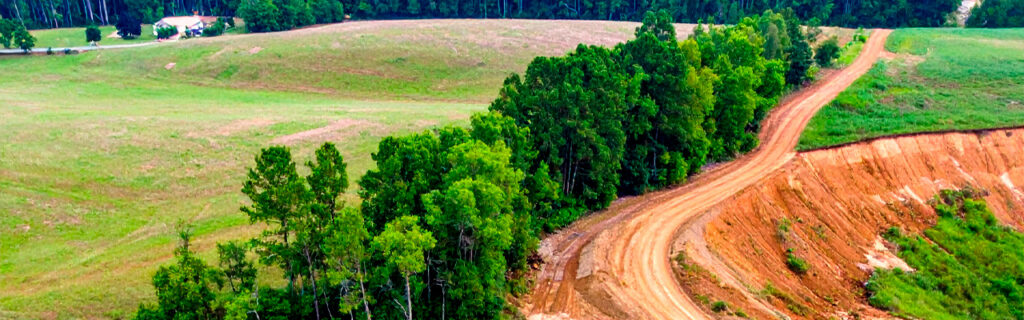
For homeowners and landowners across Ball Ground, Canton, and Cherokee County, clay soil behavior under wet conditions affects everything from how quickly a driveway can be used after rain to whether equipment can safely access a work area to how stable large trees remain during wind events following sustained rainfall. The properties in this region that are managed most effectively over the long run are those whose owners understand what extended rainfall does to clay soil and make land use, improvement scheduling, and vegetation management decisions that work with those behaviors rather than against them.
What Makes Clay Soil Different From Other Soil Types in North Georgia?
Clay soil is defined by its fine particle structure. Clay particles are microscopic platelets that pack tightly together and have large surface area relative to their volume. This particle structure gives clay soil characteristics that are fundamentally different from the sandier or loamier soils found in other regions, and those characteristics determine how clay behaves under the range of moisture conditions that North Georgia’s climate delivers throughout the year.
The fine particle structure that defines clay creates low permeability, meaning water moves through clay soil slowly compared to sandier soil types. It creates high surface area per unit volume, which allows clay particles to hold water molecules through adhesion and capillary forces, keeping the soil wet longer after rain than more porous soils would. And it creates volume instability under moisture change, meaning clay expands when it absorbs water and contracts when it dries, with each expansion and contraction cycle exerting mechanical forces on anything in contact with the soil including foundations, drainage pipes, and tree root systems.
The piedmont clay soils of Cherokee County have these characteristics in pronounced form because they developed from the weathering of the metamorphic and granitic parent rocks that underlie the region. They are typically deeper and more uniform in their clay content than soils in areas with more varied geology, which means the low permeability, volume instability, and moisture retention behaviors that affect land use decisions extend through significant soil profile depths rather than being limited to a thin surface layer above a more permeable subsoil.
How Does Extended Rainfall Change the Physical Behavior of Clay Soil?
Extended rainfall does not simply wet clay soil. It progressively saturates the soil profile from the surface downward, replacing the air in soil pore spaces with water and transforming the mechanical behavior of the soil at each depth as saturation reaches it. Understanding this progressive saturation process and what it means for soil behavior at different depths explains why a week of rain creates very different conditions than a single heavy storm, and why surface appearance after extended rain is such an unreliable indicator of actual soil conditions at the depths that matter for structural and equipment applications.
Loss of Bearing Capacity and Shear Strength
Bearing capacity is the ability of soil to support a load applied to its surface without failing or deforming excessively. Shear strength is the soil’s resistance to forces that would cause it to slide or flow laterally. Both of these properties depend on the frictional contact between soil particles and the cohesion that water surface tension provides in partially saturated clay. When clay becomes fully saturated, the water that fills the pore spaces between particles does not carry load the way the particle-to-particle contacts do. Instead, water pressure within the pores reduces the effective stress between particles, lowering both bearing capacity and shear strength dramatically.
On a practical level, fully saturated Cherokee County clay that had adequate bearing capacity to support vehicle traffic in dry conditions may not support the same loads after a week of rain without rutting, sinking, or flowing laterally under the applied load. This bearing capacity loss is why equipment access to rural properties becomes problematic after extended rain and why vehicles that travel routes that were firm before the rain create the deep ruts that are so characteristic of wet-season driveway and road damage in the area.
Volume Expansion and Upward Pressure
Clay particles expand when they absorb water through a process related to their surface chemistry and the way water molecules are attracted to clay particle surfaces. This expansion, which can increase the volume of clay by several percent when moving from dry to saturated conditions, is not uniform or benign. Clay expansion creates upward pressure against anything resting on or embedded in the soil, including foundation footings, drainage pipes, fence posts, and tree root systems. Repeated cycles of expansion and contraction as the soil wets and dries are a primary driver of the foundation movement, drainage pipe displacement, and fence post heaving that property owners in Cherokee County deal with as ongoing maintenance issues.
Lateral Instability on Slopes
On sloped terrain, the combination of saturated clay’s reduced shear strength and the gravitational force acting on the water-heavy soil mass creates conditions where lateral movement of the soil itself becomes possible. This movement ranges from the gradual soil creep that is responsible for the tilting of fence posts and utility poles on North Georgia hillsides over multiple seasons to the more acute shallow slope failures that can occur when saturated clay on a steep slope loses enough shear strength to slide as a mass rather than remaining in place. Neither of these movement types is predictable from surface observation alone, which is why extended rainfall on sloped North Georgia properties should prompt attention to any structures, trees, or improvements on or at the base of significant slopes.
How Does Extended Rainfall Affect Drainage on Clay-Based Properties?
The drainage consequences of extended rainfall on Cherokee County clay soil are more severe and longer-lasting than the drainage consequences of the same rainfall on more permeable soil types. Understanding why helps property owners set accurate expectations for how long drainage problems will persist after extended wet periods and what drainage improvements are actually capable of accomplishing in a clay-dominated soil environment.
When clay soil reaches saturation, its infiltration rate approaches zero. Rainfall that arrives after the soil is already saturated becomes entirely surface runoff because there is no available pore space in the soil to accept additional water. This one hundred percent runoff condition during the latter portions of an extended rain event generates surface water volumes that are significantly larger than the property’s drainage infrastructure was designed to handle under normal conditions, and it explains why drainage failures that occur during the second half of a week-long rain event are often more severe than those that occur during the first storm of a wet period.
After extended rainfall stops, saturated Cherokee County clay drains slowly because its low permeability limits how quickly the water that entered the soil can move downward through the soil profile to drainage outlets. Properties that appeared well-drained during dry periods may show standing water, soft ground, and drainage problems for days to over a week following extended rainfall because the clay profile is releasing its stored water gradually rather than draining quickly. This extended post-rain saturation window is the period of highest risk for equipment-related soil damage, tree root instability, and slope movement, all of which are driven by the soil’s sustained weak mechanical state during the slow drainage period.
How Does Clay Soil Behavior After Rain Affect Land Use Decisions?
The behavioral transformation of clay soil under extended wet conditions creates practical constraints on how rural and residential properties in Cherokee County can and should be used during and after sustained rain periods. These constraints are not limitations to work around at cost to the property. They are the natural behavior of the soil that, when respected, prevents the damage that working against those behaviors consistently produces.
Equipment and Vehicle Access
Vehicle and equipment travel on saturated clay soil creates compaction and rutting damage that persists long after the soil surface appears to have dried. The compressed, remolded clay left in equipment tracks has lower permeability and less pore space than undisturbed clay, which means it drains more slowly in future rain events and supports less vegetation root activity than the surrounding undisturbed soil. For property owners planning equipment-intensive work including land clearing, grading, or construction, allowing adequate drying time after extended rain before scheduling equipment-based work protects both the work quality and the long-term soil condition of the property.
For land clearing projects specifically, the soil condition left by clearing on saturated clay affects everything the property owner plans to do with the cleared area afterward. Severely compacted clearing areas may need aeration, amendment, and extended recovery periods before they can support the vegetation establishment, grading work, or agricultural use that the clearing was intended to enable.
Construction and Grading Scheduling
Grading and foundation work on saturated clay cannot achieve the accuracy and compaction quality that these operations require because saturated clay deforms unpredictably under the loads applied by grading equipment and does not compact to adequate density under normal compaction effort when wet. Projects that require accurate grade and structural compaction must wait for soil moisture to return to appropriate levels before those phases of work can produce results that will hold under load and over time. Understanding this timing requirement and building adequate weather contingency into project schedules is one of the most important applications of clay soil knowledge for North Georgia property owners planning outdoor construction.
Professional grading and excavation contractors with consistent Cherokee County experience understand the soil moisture requirements for quality grading work and routinely assess conditions before proceeding rather than working regardless of what the soil is doing. This professional judgment about soil conditions is one of the most valuable contributions an experienced local contractor brings to a project because it prevents the rework and performance problems that wet-condition grading creates for every subsequent project phase built on its results.
Slope Use and Stability Assessment
Activities on slopes including foot travel, vehicle use, and equipment operation should be limited during and immediately after extended rainfall when saturated clay reduces slope stability. The window of elevated slope instability risk extends for several days after rain stops because the clay profile continues to hold saturation-level moisture for an extended period after the surface appears to have dried. Postponing non-urgent equipment access to sloped areas, avoiding disturbing slope surfaces that are still soft, and inspecting the bases of slopes for evidence of soil movement during the saturation period are all practical behaviors during the post-rain recovery period on properties with significant slope.
What Happens to Clay Soil When It Dries After Extended Saturation?
The drying behavior of saturated clay soil after extended rainfall creates a second set of conditions that property owners should understand because they affect land use decisions and soil performance in the days and weeks following the wet period. Clay does not simply return to its pre-saturation state when it dries. It goes through a drying process that creates surface conditions distinctly different from either the saturated state or the normal moist state, with implications for vehicle travel, seeding, and equipment work during the transition period.
As saturated clay begins to dry from the surface down, the surface layer dries faster than the subsurface because it is exposed to air and sun while the clay below remains at or near saturation. This differential drying creates a surface crust that can appear firm and dry while the clay below the crust remains soft and unsupported. A vehicle or equipment that breaks through the surface crust finds wet, soft clay beneath it and immediately begins creating the rutting and compaction damage that the firm-appearing crust concealed. The practical implication is that the surface appearance of a drying clay soil after extended rain significantly underrepresents the actual soil condition at the depths where load-bearing and compaction consequences occur, and that several consecutive dry days are needed before the soil profile dries sufficiently to support equipment travel without damage.
The drying surface crust also has lower permeability than undisturbed clay because the drying process restructures the clay particle arrangement at the surface into a more consolidated configuration. This surface sealing reduces infiltration during subsequent rain events and contributes to the increased runoff that well-established Cherokee County properties experience through the wet season as repeated saturation and drying cycles progressively seal the soil surface.
How Does Understanding Clay Soil Behavior Improve Property Management?
Property owners who understand how clay soil behaves under extended wet conditions make better decisions across every aspect of land management that involves timing, scheduling, and soil condition assessment. Specific management improvements that follow directly from understanding clay soil behavior include:
- More realistic project scheduling: Understanding that Cherokee County clay requires several consecutive dry days after significant rainfall before it returns to equipment-workable condition allows property owners to schedule construction, clearing, and grading projects with realistic weather contingency rather than fixed timelines that assume favorable conditions regardless of what the weather does.
- Better drainage improvement decisions: Understanding that clay soil’s low permeability limits how much drainage improvement can be achieved through infiltration-based approaches directs investment toward surface drainage corrections, swales, and outlet improvements that move water across the surface to managed outlets rather than relying on the soil to absorb it.
- Proactive erosion control on disturbed areas: Understanding that disturbed clay soil under North Georgia rainfall conditions loses topsoil rapidly motivates prompt erosion control on any bare or recently disturbed area rather than treating post-disturbance erosion control as a deferred maintenance task.
- Informed tree hazard assessment timing: Understanding that saturated clay reduces tree root anchoring capacity motivates post-rain tree inspections focused on large trees near structures, particularly after extended wet periods that produce deep profile saturation rather than just surface moisture.
- Foundation drainage prioritization: Understanding that clay volume change under moisture cycling creates ongoing mechanical pressure against foundation elements motivates treating foundation drainage as a maintenance priority rather than a one-time construction decision that requires no ongoing attention.
What Improvements Help Manage Clay Soil Behavior on North Georgia Properties?
While clay soil behavior under wet conditions cannot be eliminated, specific improvements reduce its impact on drainage, stability, and land use practicality on North Georgia properties. These improvements work with the soil’s natural behavior by managing where water goes rather than trying to change how the clay absorbs it.
Grading that establishes positive drainage away from structures and toward managed outlets is the foundational improvement for clay-soil drainage management. On clay soil that cannot absorb water quickly, surface drainage that moves runoff away from sensitive areas efficiently during rain events is more effective than any infiltration-based approach. Swale installation, foundation zone regrading, and driveway drainage correction all work by improving surface water movement rather than by changing soil permeability.
Vegetation establishment and maintenance is the most cost-effective long-term clay soil management strategy available. Established grass and ground cover protect the soil surface from raindrop impact that dislodges particles and promotes crusting, improve the soil’s macrostructure through root activity that creates preferential flow paths for water, and provide the erosion resistance that prevents the topsoil loss that progressively worsens clay-soil drainage conditions over time. Forestry mulching on areas being cleared for the first time creates an organic mulch layer that protects the clay surface during the vulnerable post-clearing period before new vegetation can establish, which is particularly valuable on the clay slopes common across Cherokee County rural properties.
Frequently Asked Questions
How do I know if my property’s soil problems are related to clay behavior or something else?
Clay-related soil problems in Cherokee County follow predictable patterns that correlate with moisture conditions. If your property experiences drainage problems that worsen consistently through wet seasons, driveway damage that follows each extended rain period rather than occurring randomly, foundation moisture that correlates with rain events, and difficulty establishing vegetation on bare slopes, these patterns are characteristic of clay soil behavior under North Georgia’s rainfall conditions. Problems that occur independently of moisture conditions or that affect only isolated areas without correlation to drainage patterns may have other causes that warrant separate investigation.
Can clay soil be permanently improved to drain better on rural properties in Cherokee County?
Permanent improvement of clay soil drainage through soil amendment is practical only on small areas where the cost and effort of deep amendment is manageable, such as garden beds and specific planting areas. On the scale of rural acreage, improving drainage through soil amendment is not practical. The sustainable approach to clay-soil drainage management on rural properties is surface drainage design that moves water across and off the property efficiently rather than relying on the soil to absorb it, combined with vegetation management that maximizes the biological improvement of soil structure that plant root systems contribute over time.
Why does my Cherokee County lawn stay wet and soft for so long after rain compared to properties I have seen in other regions?
The extended wet-soil period after rain on Cherokee County properties compared to regions with sandier or loamier soils is a direct function of clay’s low permeability and high water retention capacity. Sandy soil drains within hours of rain because its large pore spaces allow water to move through it quickly. Cherokee County clay drains over days because its small pore spaces and particle surface chemistry hold water longer and release it slowly. This is normal behavior for the soil type and does not indicate a drainage problem unless standing water persists beyond the expected timeframe for clay conditions, which is typically two to three days for normal moisture in lawn areas with adequate surface drainage.
Does the clay soil behavior in Cherokee County affect what grass varieties perform best?
Yes. Grass varieties that tolerate periodic soil saturation and recover quickly from it perform better on Cherokee County clay than those requiring continuous good drainage. Bermudagrass and zoysiagrass, which are the most commonly recommended warm-season grasses for North Georgia lawns, both have reasonable tolerance for periodic saturation and recover well from wet-season stress when the drainage conditions of the site are otherwise managed adequately. Tall fescue performs well in shaded areas where warm-season grasses struggle and also tolerates the moisture conditions common in Cherokee County. Varieties requiring excellent drainage are poor choices for clay-dominant sites without significant drainage improvement infrastructure in place.
How does clay soil behavior after rain affect the timing of tree removal projects?
Clay soil saturation after extended rainfall affects tree removal project timing in two ways. First, the reduced bearing capacity of saturated clay limits where removal equipment can safely travel without creating severe rut damage, which may restrict the access available for the removal operation. Second, root plate instability in saturated clay means that trees with marginal structural conditions may fail unexpectedly during the removal process rather than responding predictably to the cutting sequence. Experienced tree removal contractors in Cherokee County assess soil conditions before scheduling equipment-based removal work and adjust their approach when saturated conditions are present, which sometimes means delaying until conditions improve or modifying the removal technique to account for the soil condition.
Ready to Work With Your Property’s Clay Soil Conditions?
Clay soil is not a problem to solve. It is a site condition to understand and work with effectively. The properties across Cherokee County that are managed most successfully over the long run are those whose owners understand what extended rainfall does to clay soil, make scheduling and land use decisions that respect those behaviors, and invest in surface drainage improvements that move water off the property efficiently rather than waiting for the clay to absorb it. That approach produces more functional, more durable, and more cost-effective land management outcomes than fighting the soil’s natural behavior with approaches that are not suited to what clay-dominant terrain actually requires.
Bardin Outdoors works with homeowners and landowners across Ball Ground, Canton, Cherokee County, and North Georgia on land improvement projects planned and executed with full understanding of how local clay soil conditions affect every phase of clearing, grading, drainage, and site preparation work. To learn more about how Bardin Outdoors can help your property with clay-soil drainage and land improvement challenges, contact us.