For property owners across Cherokee County, Ball Ground, and Canton planning any outdoor improvement that involves ground preparation before construction, surface treatment, or structural work, understanding the distinction between site preparation and site development, and how each applies to the specific projects they are planning, gives the foundation for approaching contractor conversations with accurate expectations and for evaluating proposed project scopes with the clarity about what each phase includes and what it is intended to accomplish. North Georgia’s specific soil, terrain, and geological conditions affect what each phase requires in this region relative to simpler improvement environments, and those regional specifics are part of what property owners need to understand before committing to any project scope that involves ground-disturbing work on Cherokee County residential or rural land.
Defining Site Preparation and What It Encompasses
Site preparation is the work that converts a site from its existing condition to the subgrade condition that development work requires to proceed effectively. It is the work that happens before any structural element, surface material, or permanent improvement is placed on the site, and its purpose is to establish the physical and drainage conditions that those subsequent improvements will depend on for their long-term performance. Site preparation does not produce a finished product that the property owner can point to as the completed improvement. It produces a prepared site condition from which the development work that follows can produce that finished improvement correctly.
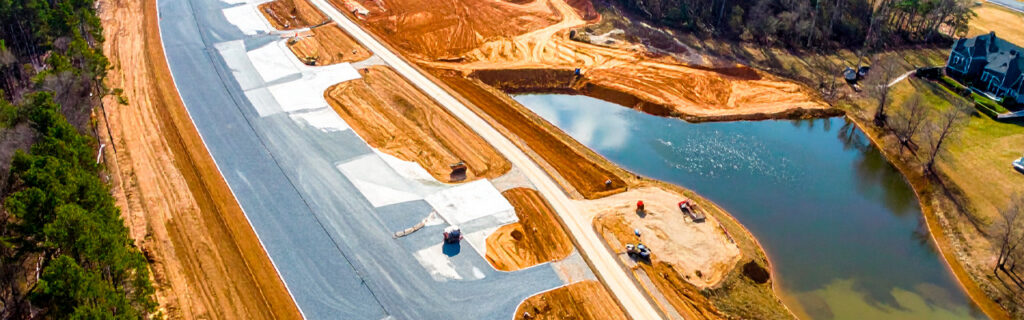
The specific work that site preparation encompasses varies with the current site condition and the intended development, but it consistently addresses the categories of work that must be completed before development can proceed on adequate subgrade conditions. Vegetation clearing that removes the plant material occupying the site is site preparation. Organic topsoil stripping that removes the decomposable organic layer from zones where structural fill or foundations will be placed is site preparation. Rough grading that moves earth to approximate design elevations from the current terrain is site preparation. Subgrade compaction that consolidates fill material to adequate structural density is site preparation. Drainage infrastructure installation that establishes the underground drainage system the site requires before its surface is finished is site preparation. Each of these activities contributes to the prepared site condition that development work requires rather than to the finished improvement that the development work produces.
Defining Site Development and What It Encompasses
Site development is the work that converts a prepared site into the finished improvement that the project was intended to create. It is the work that produces the outcomes the property owner will use, observe, and assess after the project is complete, and its quality depends directly on the quality of the site preparation that preceded it. Site development includes the finished grading that achieves precise design elevations and drainage grades from the rough grade that preparation established, the surface material placement that creates the travel surface, lawn surface, or structural surface that the development produces, the structural construction of buildings, driveways, retention features, and other permanent improvements that development creates, and the revegetation or landscape establishment that completes the site’s intended surface condition.
Site development produces observable progress that property owners recognize as improvement work because it creates the finished features that the project was intended to deliver. Finished grading that establishes the precise drainage grades around a building pad is site development. Gravel surface placement on a prepared driveway subgrade is site development. Building construction on a prepared and compacted building pad is site development. Seeding and erosion control mat installation on finished slopes is site development. These development activities create the improvements that the property owner will use, but their performance is determined by the preparation work that established the subgrade conditions they were built on rather than by the development work itself, which is the practical reason that site preparation quality directly determines site development performance quality across the improvement’s service life.
Why the Distinction Matters for Project Planning and Budgeting
The practical importance of understanding the distinction between site preparation and site development for property owners lies primarily in project budgeting and scope evaluation. Site preparation costs are frequently underestimated or omitted from early project budget discussions because they do not produce the visible improvements that development costs create, leading property owners to be surprised when contractor proposals include significant preparation scope that they had not anticipated or that they had assumed was included in the development scope at a lower cost than it actually represents.
A building project budget that accounts for building construction costs but not for site preparation costs including clearing, grading, drainage, and subgrade preparation will be significantly incomplete. The building construction that the development phase requires cannot proceed without the site preparation that the preparation phase must accomplish first, which means the preparation costs are not optional items that the project can proceed without but essential prerequisites that must be included in any complete project budget. When property owners discover the preparation costs after development costs have already been committed, they face the choice of proceeding with a budget that exceeds what they anticipated or compromising the preparation quality that the development’s performance depends on, neither of which is a satisfactory outcome that adequate initial budgeting including both phases would have produced.
Understanding the distinction also helps property owners evaluate contractor proposals that may describe a project as site preparation when it includes development scope, or that may describe a project as site development without including the preparation scope that adequate development performance requires. A proposal for driveway site development that does not include subgrade preparation and drainage infrastructure installation is a proposal for development without preparation that will produce a driveway that performs below its surface material’s capability because the inadequate preparation beneath it limits its performance regardless of the surface material quality above it.
How Site Preparation Phases Sequence on North Georgia Properties
Site preparation on Cherokee County residential and rural properties follows a specific sequence of activities where each activity creates the conditions that the following activity requires to proceed effectively. Understanding this sequence helps property owners follow the logic of project proposals that include multiple preparation activities rather than treating the preparation as a single undifferentiated cost item.
Clearing as the First Preparation Phase
Land clearing is the first preparation activity on vegetated sites because grading and excavation equipment cannot achieve accurate results on surfaces where root systems and organic material create irregular bearing and cutting conditions beneath the equipment. Clearing removes the above-ground vegetation and, for sites requiring structural subgrade preparation, the below-ground root systems that would otherwise remain as organic inclusions in the graded subgrade. It also reveals the actual ground terrain that exists beneath the vegetation, which on wooded Cherokee County properties is frequently different from what aerial imagery or edge observation suggested before clearing exposed the actual ground surface. This terrain revelation is itself a preparation outcome, because the grading design that must work with the actual terrain cannot be accurately finalized until clearing exposes what that terrain actually is.
Organic Stripping After Clearing
After clearing exposes the ground surface, the organic topsoil layer must be stripped from any area where structural fill will be placed or where foundations will bear before earthmoving that shapes the subgrade to design elevation begins. Organic topsoil that is stripped and stockpiled can sometimes be reused for final surface topdressing or revegetation of disturbed areas after development is complete, but it cannot remain beneath structural fill or foundations without creating the settlement problems that decomposing organic material buried under structural loads consistently generates. The depth of stripping required varies with site history and determines the stripping volume that the preparation budget must account for at each specific location.
Rough Grading to Approximate Design Elevations
Rough grading moves earth from areas above design elevation to areas below, creating the approximate terrain configuration that development requires within several inches of design elevation targets. This phase uses heavy earthmoving equipment that efficiently handles large material volumes but that does not produce the precision that finished grading requires. The rough grade is not the finished grade. It is the starting condition from which finished grading achieves the precise elevations that drainage and structural performance require, which is why rough and finished grading are typically described as separate activities even when they are executed sequentially by the same contractor without a significant interval between them. Rough grading on Cherokee County’s rolling terrain produces the significant cut-and-fill volumes that the region’s elevation variation creates, which is the primary driver of earthwork cost on most North Georgia improvement projects and the phase most commonly underestimated from visual terrain assessment.
Subgrade Compaction to Structural Density
After rough grading establishes approximate design elevations, the fill material placed to achieve those elevations must be compacted to the structural density that development work will require from the subgrade it rests on. Cherokee County clay’s compaction behavior is moisture-dependent, requiring that compaction be scheduled for conditions when the clay is at or near its optimum moisture content for compaction rather than at the saturated moisture content that spring wet season and post-rain conditions create and that prevents adequate compaction density from being achieved regardless of effort applied. Compaction that is achieved at appropriate moisture conditions and verified against the specified density standard is preparation work that supports development quality. Compaction attempted at inappropriate moisture conditions produces an apparently compacted surface that will not perform to specification under development loads and the moisture cycling that Cherokee County’s seasonal pattern delivers through the improvement’s service life.
Drainage Infrastructure Installation
Underground drainage infrastructure including foundation perimeter drains, culverts at drainage crossings, and drainage swales or channels that manage water movement beneath and adjacent to the site must be installed during the preparation phase rather than after development is complete, because the development work that follows preparation covers the positions where drainage infrastructure must be installed. A foundation perimeter drain that was not installed during site preparation cannot be added after the building is constructed without excavating through the finished landscape and potentially through the building’s foundation system to reach the installation positions that the preparation phase could have accessed before anything was built above them. Correct drainage infrastructure installation during site preparation is therefore the permanent commitment point for drainage performance that the development phase builds on rather than a detail that can be deferred or retrofitted without major disruption and cost after development is complete.
How North Georgia’s Conditions Make Site Preparation More Consequential
The specific conditions that characterize Cherokee County residential and rural properties make site preparation quality more consequential for long-term development performance than equivalent preparation would be in simpler improvement environments. Understanding how local conditions affect preparation requirements helps property owners evaluate whether proposed preparation scopes are adequate for the conditions they will address or whether they reflect generic planning assumptions that North Georgia’s actual conditions do not support.
Cherokee County clay’s moisture sensitivity and volume change behavior create preparation requirements that more permeable, more stable soil types do not need at the same level of specificity. Organic topsoil depth on wooded sites in the region is frequently greater than preparation budget assumptions from other regions would anticipate, and discovering the actual depth during active preparation rather than before commitment is one of the most common sources of preparation budget overruns on Cherokee County wooded site projects. Subsurface rock probability at specific topographic positions in the region requires contingency planning that regions with deeper residual soils over bedrock do not need as consistently. And the rolling terrain that characterizes most Cherokee County residential and rural lots produces cut-and-fill earthwork volumes that visual terrain assessment consistently underestimates, making physical interior terrain evaluation before scope commitment the most important preparation planning step for accurately budgeting the rough grading that will dominate earthwork cost on most improvement projects.
How Site Preparation Quality Determines Site Development Performance
The relationship between site preparation quality and site development performance is not theoretical. It is the direct physical relationship between what the subgrade conditions are and how the improvements resting on those conditions will perform across their service lives. Every development-phase improvement, from a building foundation to a gravel driveway to a seeded lawn surface, performs at the level its underlying preparation allows it to perform rather than at the level its materials and construction quality would achieve on an adequately prepared site.
A gravel driveway placed on an inadequately prepared subgrade with insufficient crown and drainage will displace surface material and develop ruts in wet conditions regardless of the gravel quality, the depth of surface material, or the care with which the surface was placed. The preparation deficiency below overrides the development quality above. A building foundation placed on inadequately stripped and compacted subgrade will settle in the locations where organic material was not removed or where fill was not adequately compacted regardless of the foundation design quality or the construction materials used. The preparation deficiency produces the outcome, not the development deficiency. A seeded lawn established on inadequately graded, poorly drained subgrade will develop the chronic wet patches, bare areas, and erosion channels that the drainage design would have prevented regardless of the seed quality or the establishment practice. The preparation outcome determines the development outcome across every improvement type, which is the practical case for treating preparation as the consequential investment it is rather than the cost to be minimized before development work can begin.
How to Evaluate Whether a Project Proposal Adequately Covers Both Phases
Property owners evaluating contractor proposals for improvement projects can assess whether both preparation and development phases are adequately covered by reviewing the proposal’s line items against the specific preparation activities that the project’s intended development requires. A building project proposal that lists grading and excavation but does not specifically address organic stripping and depth, compaction specification and verification, and drainage infrastructure installation may be proposing development-ready earthmoving without the preparation scope that produces development-ready site conditions from a site that currently requires that preparation to achieve them.
The most productive way to evaluate proposal completeness is to ask the contractor to explain how each preparation outcome that the intended development requires will be achieved through the proposed scope. Asking specifically about organic stripping depth and scope, about compaction specification and how it will be verified, about drainage infrastructure positioning and sizing, and about how the rough grade will be achieved from the specific terrain at the project location gives the contractor the opportunity to demonstrate that the proposed scope is calibrated to the actual site conditions rather than to generic assumptions, and gives the property owner the understanding of what each scope element accomplishes rather than treating the proposal as an undifferentiated cost to be compared against other proposals without reference to what different proposals do or do not include.
Frequently Asked Questions
Can site preparation and site development be executed by different contractors or does the same contractor need to do both?
Site preparation and site development can be executed by different contractors when the handoff between phases is clearly defined, when the preparation contractor’s completed work is verified against the specifications that the development phase requires before development begins, and when the development contractor has reviewed and accepted the preparation conditions before committing to the development scope. This phase handoff requires clear communication about what the preparation phase produced, specifically including compaction test results, drainage infrastructure as-built positions and elevations, and finish grade elevations at specific points across the prepared site, so that the development contractor can design or confirm development scope from accurate information about the conditions they will be working from rather than from assumptions that the preparation may or may not have satisfied. The same contractor executing both phases simplifies this handoff because the preparation quality is known directly to the contractor proceeding with development, but the handoff between different contractors can be managed successfully when preparation documentation is thorough and development contractor review of prepared conditions precedes development commitment.
Are there project types on North Georgia properties where site preparation and site development are practically indistinguishable?
On some smaller projects with modest preparation requirements and relatively simple development scope, the preparation and development phases can be executed so closely in sequence that they appear to be a single continuous operation rather than distinct sequential phases. A small trail clearing and surface improvement project on firm, organically shallow, naturally drained terrain may complete both clearing and surface material placement in a single contractor visit without a meaningful interval between preparation completion and development beginning. A modest gravel pad for equipment storage on an existing cleared area with adequate subgrade may require only minor grading correction and surface material placement that together constitute both minimal preparation and simple development in a sequence too compressed to distinguish as separate phases. These compressed-phase projects are distinguished from larger projects with significant preparation requirements by the scale of preparation work relative to the site’s current condition, and the distinction between preparation and development remains conceptually valid even when the execution is practically continuous.
What documentation should be produced at the end of the site preparation phase before development begins?
The documentation most useful at the conclusion of site preparation and before development begins includes compaction test results at representative points across the prepared subgrade confirming that specified density was achieved, photographs of the prepared site surface condition from multiple angles showing the rough grade configuration and the drainage infrastructure installation positions, notes or measurements of the drainage infrastructure as-built positions and elevations at key points including culvert invert elevations and drainage outlet positions, and a summary of any conditions encountered during preparation that differ from the pre-preparation assessment and that the development phase should account for. This documentation creates the record that supports development-phase design confirmation, that enables the handoff between different contractors executing different phases to be based on documented conditions rather than assumed conditions, and that supports any future warranty or performance discussion about development-phase outcomes that the preparation conditions contributed to. For larger projects with building permits, this documentation may be formally required as part of the permit compliance record rather than simply being useful as a project management tool.
How does the distinction between site preparation and site development affect how I should communicate with my contractor about project scope?
Understanding the distinction allows property owners to ask specifically about both phases when evaluating a project rather than discussing only the development outcome and assuming that adequate preparation is implied by the development commitment. Asking a contractor to describe what site preparation will be required before development can proceed, and then asking how that preparation is addressed in the proposed scope, produces the conversation that confirms whether the proposal is complete or whether it addresses only the development phase with preparation either omitted or assumed to be already adequate without specific assessment. This conversation is most productive before any scope is committed, because the property owner’s understanding of what preparation is needed and what the proposal includes for preparation allows the proposal to be evaluated against the actual project requirements rather than against a development-only cost comparison that omits the preparation costs that a complete project requires.
Planning a Site Preparation or Development Project on Your North Georgia Property?
The distinction between site preparation and site development is the distinction between the work that makes development possible and the work that development produces, and it is a distinction that affects every project planning decision from initial scope definition through contractor selection, budget commitment, phase sequencing, and long-term performance expectation. Property owners who understand both phases and what each requires of the specific conditions at their project site are equipped to evaluate project proposals with the completeness that a project spanning both phases requires, to budget for the full scope that adequate preparation and quality development together demand, and to hold both phases to the standards that the improvement’s long-term performance depends on rather than discovering through the performance failures of inadequately prepared development that the preparation phase was the consequential investment that its invisibility in the finished improvement understated.
Bardin Outdoors works with homeowners, landowners, and builders across Ball Ground, Canton, Cherokee County, and North Georgia on site preparation and grading and excavation projects that address both phases with the quality and sequencing that North Georgia terrain and soil conditions require for development performance that meets its intended standard across the full service life of the improvements being built. To learn more about how Bardin Outdoors approaches site preparation and site development on North Georgia properties, contact us.